
6 January 2026
The Moroccan People — A Personal Encounter (Beyond Fes)
At this point in the journey, I think it’s worth talking less about landmarks and more about people — and not just in Fes, but Morocco more broadly. What I experienced here echoed what we felt across the country.
From my personal experience, English is generally quite okay in tourist areas. Of course, if you speak Arabic or French, interactions become easier, but communication was rarely impossible. More importantly, people were friendly, often curious, and usually open.
Yes, Morocco has a tips-oriented culture, but it didn’t feel forceful. If you avoid the more scam-like encounters and stick to regular services — restaurants, riads, hotels — it doesn’t feel like pressure, more like expectation. Encouraged, yes; forced, no.
Moroccans are hospitable, and while tourists everywhere are a kind of “cash cow,” that’s true in most destinations. What stood out to me in Morocco was the genuine desire for visitors to enjoy the place. I often felt that people wanted us to leave liking the country, not just having spent money in it. That warmth felt sincere and, honestly, heart-warming.
One thing that surprised me was how aware people are of Malaysians. Malaysians seem to travel here quite often — or at least Malaysia is familiar to many locals. Later, during our Sahara tour, we even met a large Malaysian family travelling together. That small sense of recognition was unexpectedly comforting.
Understanding Fes: Medina, New City, and a Layered Past
Fes is not just old — it is layered.
Founded in 789 AD by Idris I, Fes became Morocco’s spiritual, cultural, and intellectual heart. The historic Fes el-Bali Medina, now a UNESCO World Heritage Site, is one of the world’s largest car-free urban zones and has largely preserved its medieval street layout.
Later came Fes el-Jdid, developed in the 13th century under the Marinid dynasty, housing royal palaces and the Mellah (Jewish quarter). During the French Protectorate in the early 20th century, Ville Nouvelle was added — wider roads, cafés, administrative buildings — a stark contrast to the dense, maze-like medina.
Walking through Fes means moving through centuries of history within minutes, often without realising it.

Weather, Breakfast, and Stepping Into the Medina
This was our official walking day in Fes. The forecast predicted intermittent rain, so we started with some hesitation.
We had breakfast at our riad, and many riads in Fes include breakfast as standard. It’s usually not a buffet — mostly different kinds of bread, eggs, jams, and mint tea — but we enjoyed it tremendously. For me, though, it was really about the coffee. I need caffeine to feel alive.

The rain turned out to be just a light drizzle — perfect walking weather.
We began our walk at Bab Bou Jeloud (the Blue Gate), the iconic western entrance to the medina. From there, the city immediately came alive: narrow streets filled with shops selling leather goods, ceramic tiles, brass lamps, babouche slippers, scarves, earrings, spices, wooden combs, woven baskets, metal trays, and countless other crafts. The medina is loud, colourful, and textured — history stacked on top of daily life.


Finding a Sahara Tour Agency: When Google Maps Helps — and When It Doesn’t
One of our main tasks that day was to book a 3-day, 2-night Fes to Merzouga Sahara tour. We had done our online research but wanted to speak to an agency face to face, hoping to find something that felt more trustworthy.
We walked. And walked. And walked.
Lesson learned: Google Maps in Fes is useful — but with limits.
For general directional guidance while walking, Google Maps is still helpful. It gives you a sense of where you are relative to gates, main streets, and landmarks. But when it comes to tour agencies and businesses, accuracy drops sharply.
We visited five agencies marked on Google Maps, all chosen based on online reviews — and none of them physically existed. Some were only meeting points; others were entirely online operations.
Only later, after giving up and contacting an agency online at night, did we realise many operators list themselves on Maps simply to make it easier for tourists to “find” them — even without a brick-and-mortar office.
There are actual tour agencies on the ground in the medina, but not many. The few we found had weaker reviews, so we decided not to use them.
In the end, we spent more than two hours walking around looking for nothing. Ironically, it turned into an unplanned city walk — and in a way, that felt very Fes.
Sahara Tour Booking Notes
- Price paid: €190 per person (3 days / 2 nights)
- Online prices usually range €230–250
- Includes accommodation, most breakfasts & dinners
- Winter tip: insist clearly on a heated desert camp
- We paid a PayPal deposit, balance on pickup
We said clearly to the agency — heating was non-negotiable. They confirmed it, and with some trepidation, we booked.
Chouara Tannery: Two Buildings, Two Perspectives

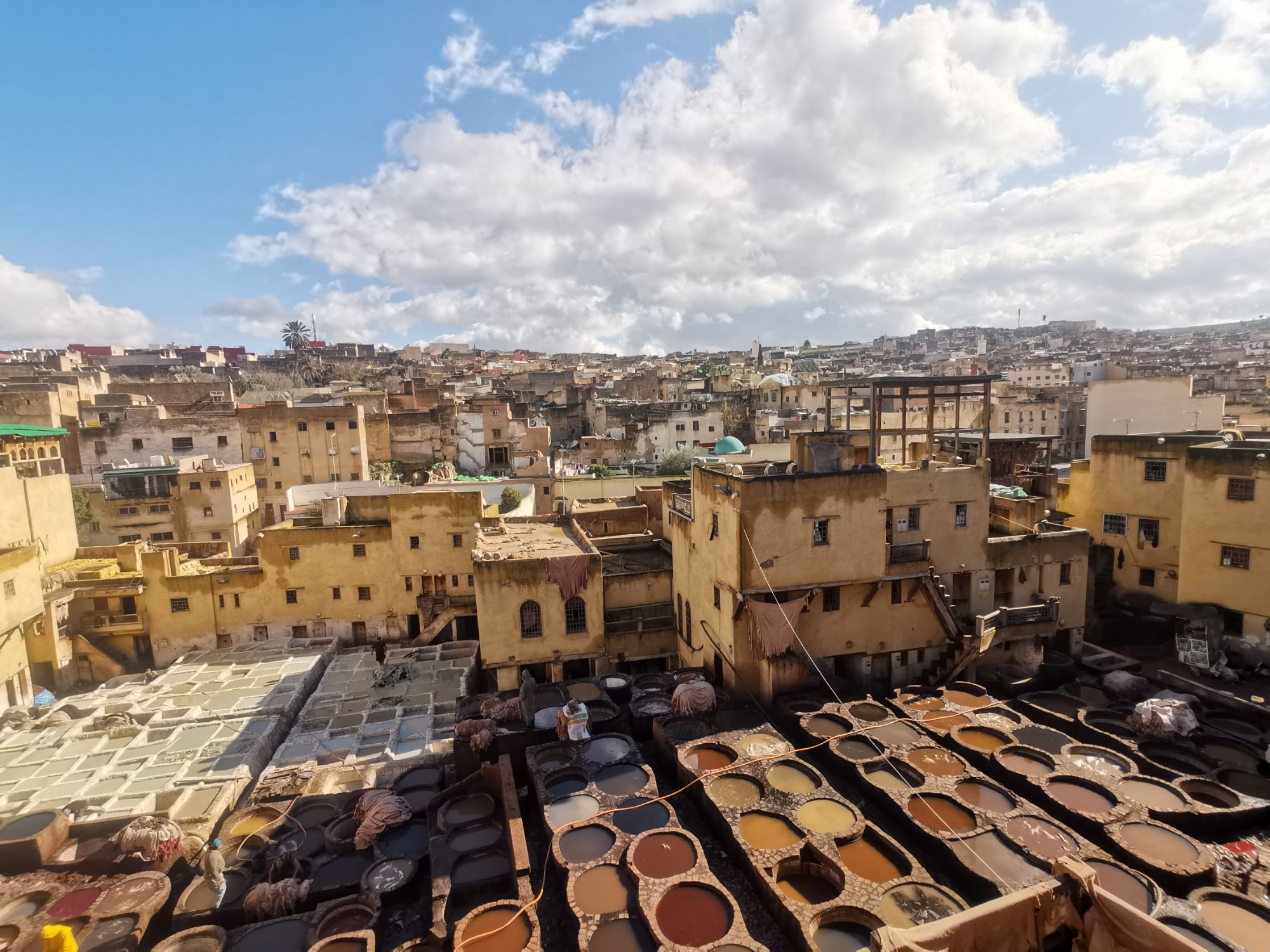
With tour booking paused, we returned to sightseeing. Chouara Tannery, one of the oldest leather tanneries in the world, was next.
We visited two different buildings to see the tannery.
The first building offered a farther, more distant view. It allowed us to see the general layout — stone vats clustered together like a giant painter’s palette — but the angle wasn’t ideal.
Unsatisfied, we tried again.
The second building came with an older guide who led us upstairs. We knew a tip would be expected later, but we followed him anyway. This view was closer and more detailed — not necessarily the best in Fes (I’m still not convinced I ever found that), but clearly better than the first.
He explained how leather production in Fes has remained largely unchanged for over 1,000 years: raw hides soaked in limestone and pigeon droppings to soften them, then dyed using natural pigments — indigo for blue, saffron for yellow, poppy flower for red, mint for green.
They warned us about the smell, but in winter, it really wasn’t bad at all. Summer, apparently, is another story.
Afterward, we were guided through their leather shop. Prices were noticeably higher than outside. We didn’t buy anything. When the guide asked for a tip, he didn’t push further, which felt fair.
Despite the confusion, the visit was worth it. There’s little chance we’d ever encounter a living, working leather industry like this back home.


Hassle in the Streets of Fes? A Nuanced Reality
Regarding hassling — it exists, but it’s not everywhere.
One particular junction felt noticeably more aggressive. We were approached twice in two days. At one point, two boys followed us into a darker, narrower alley. We hesitated to turn where we should have, knowing hesitation often invites “help.”
They called out:
“Hello”, “Nihao”, “Wrong way”,
“No Muslim that way”, “Tannery this way”, “Medina this way”.
Often, you are actually already on the right route.
Our host later told us: if you let them guide you, they may not be satisfied with the tip and ask for more. Best approach? Ignore completely — no response, no eye contact.
It felt uncomfortable. I sometimes felt bad — some people probably just wanted to say hi, others were business owners hoping we’d browse. But caution felt necessary.
Eventually, we reached a main street by taking a longer route, and they quietly retreated back into the darkness.

Street Signs, Shapes, and Why Everyone Gets Lost
At one point, my friend and I started debating the shape of the street signs.
She said one shape meant the street was passable.
I confidently insisted it was the hexagon.
I was wrong.
In Fes:
- Hexagonal street signs indicate a dead end
- Other shapes indicate a route that passes through
So yes — my bad.
We were both quoting different sources and half-remembered online guides. Maybe that’s why so many travellers get lost in Fes. Or maybe getting lost is simply part of the experience.

Street Navigation Tips: Fes Medina
- Hexagonal street signs = dead end
- Other shapes indicate a passable route
- Google Maps is useful for general walking direction, not for locating businesses
- If someone says “wrong way,” you often aren’t
- Hesitation invites “help” — walk confidently
- Avoid following unsolicited guides
- Stick to main streets when unsure; darker alleys need more caution
Going to the Mirador: Seeing Without Fully Understanding
With all the walking and searching, we decided to go up to a mirador (viewpoint) to see the medina from above.
We took a taxi from Bab Bou Jeloud.
- Initial quote: 30 dirhams
- Negotiated to 20 dirhams
The view was expansive — rooftops, minarets, and earth-coloured walls stretching endlessly. But without context, it was hard to distinguish different districts or landmarks. We took photos, wishing we understood better what we were looking at.
A guided explanation would have made the view far more meaningful.

Ending the Day: Frustration, Success, and Reflection
Back at the riad, we finally booked our Sahara tour online. The riad owner had offered to arrange it for €230, which is understandable — commission is standard — but details were limited, and booking ourselves felt clearer.
All in all, it was a fruitful day. I genuinely enjoyed walking Fes, despite the small scare with the kids following us. I don’t think they intended harm, but being chased through narrow alleys is unsettling.
Still, Fes stayed with me. Its chaos, warmth, confusion, and humanity blended into something quietly unforgettable.



Leave a Reply