
13 January 2026
Montserrat: A Mountain of Faith and Stone
We chose Montserrat almost carelessly.
Barcelona had begun to feel familiar — the Gothic Quarter’s labyrinth, the soft golden façades, the rhythm of cafés spilling onto narrow streets. We wanted something that felt different. Something vertical. Something older than the city.
I knew very little about Montserrat. Only that it held a monastery. And that somewhere inside those mountains, boys had been singing for centuries.
That was enough.
The Mountain That Looks Like a Saw Blade
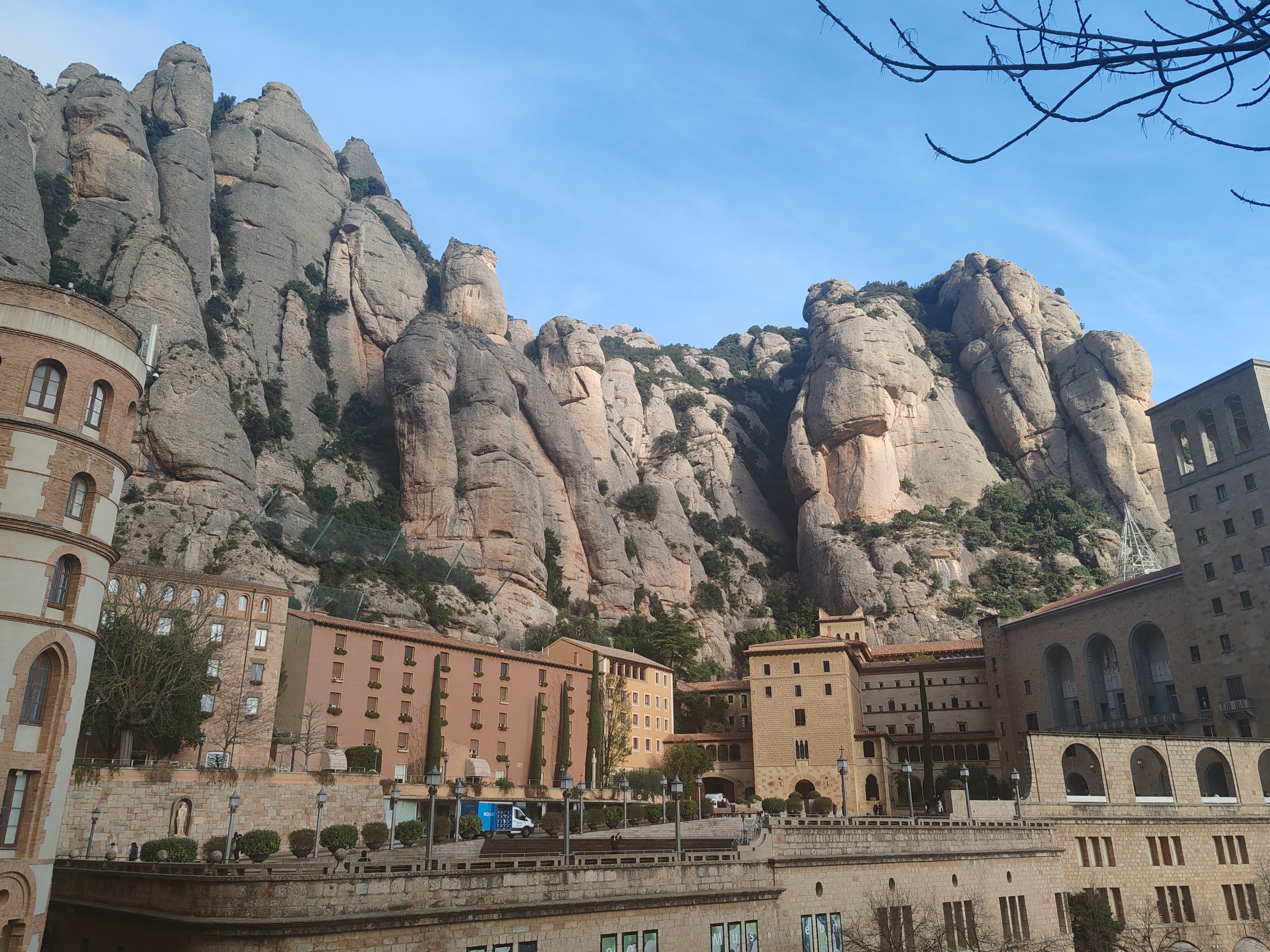
Montserrat rises abruptly from the Catalan plain like a broken cathedral carved by geology itself.
Its name means “serrated mountain,” and from afar it truly resembles a row of uneven teeth biting into the sky. These rock formations were shaped over millions of years — sediment compressed, lifted, eroded — until the landscape became something that feels almost sculpted rather than natural.
Unlike the gentle hills of other Mediterranean regions, Montserrat feels dramatic. Abrupt. Symbolic.
And perhaps that is why it became sacred.
Just an hour away from Barcelona, it feels like a different world entirely — quieter, sharper, closer to the sky.
How to Get to Montserrat from Barcelona


There are several ways to reach the mountain:
1. Train + Rack Railway (Cremallera)
FGC R5 train from Plaça Espanya → Monistrol de Montserrat → Rack railway up the mountain.
2. Train + Cable Car (Aeri)
FGC R5 train → Aeri de Montserrat → suspended cable car ascent.
3. Drive
Roughly one hour by car; paid parking available at the monastery.
4. Guided Tour
Organised coach tours including transport and monastery access.
We chose the rack railway.
Not out of strategy — simply because it felt steadier in winter.
Why We Bought Separate Bundled Tickets
Instead of purchasing the full all-in-one Montserrat package, we made a small but important decision.
We bought:
- One bundle for transport (train + rack railway return)
- Another bundle separately for attractions (museum, audiovisual, Black Madonna access)
And in hindsight, it made far more sense.
January is low tourism season. When we visited, the Sant Joan funicular was closed for maintenance — something that often happens during winter.
If we had bought the full “Tot Montserrat” style package, we would have paid for:
- Funicular rides we couldn’t use
- Extra inclusions we didn’t need
- A higher overall bundled price
By separating transport from attractions, we paid only for what we actually used.
It felt more intentional. More flexible. Less wasteful.
Sometimes, the smarter option isn’t the most convenient one — it’s the one that respects the season you’re travelling in.
Ticket Comparison Table (2026 Reference)
| Option | Includes | Ideal For | Approx Price (€) | Notes |
|---|---|---|---|---|
| Transport Only | Train + Rack Railway Return | Hikers, monastery visitors | 23–28 | Most flexible |
| Tot Montserrat Package | Transport + Museum + Funicular + Audio Guide | First-time full experience | 45–60 | Best if all services running |
| Separate Transport + Attractions (Our Choice) | Transport bundle + attraction bundle | Winter visitors | 35–45 | Smart if funicular closed |
| Guided Tour | Coach + Guide + Entry | Short stays | 60–90 | Convenience over flexibility |
Always verify seasonal closures before purchasing bundled passes.
The Ascent: Climbing Into the Cold

We boarded the rack railway:
Cremallera de Montserrat
The train climbed slowly, almost ceremonially, gripping the mountain with mechanical patience. Outside the window, the plains retreated. The air thinned. The colour palette shifted from warm city tones to cool winter stone.
It was cold.
My friend could not stop shivering.
And yet when we stepped off at the top, the cold became secondary.
The mountains stood around us like guardians — mist weaving between their peaks. For a moment, it felt as though we had stepped into a painting left unfinished by time.
More Than a Monastery: A Mountain for Hikers
I had assumed people came here only for the monastery.
I was wrong.
Many visit purely to hike.
And I understand why.
The trails wind between rock spires and viewpoints that stretch endlessly across Catalonia. At certain points, the clouds drift below eye level, and you feel suspended between earth and sky.
It was serene in a way Barcelona never is.
We hiked for about an hour before returning for scheduled visits. I could have continued for much longer. There is something addictive about quiet elevation.
The Heart of Montserrat
At the centre stands Santa Maria de Montserrat Abbey.
Founded in 1025, it is home to La Moreneta — the Black Madonna, a 12th-century Romanesque carving that has become one of Catalonia’s most important religious symbols.
Legend says shepherd children discovered the statue in a cave. When villagers tried to move it, it became impossibly heavy — interpreted as a divine sign that it should remain on the mountain.
During Franco’s dictatorship, when Catalan culture was suppressed, Montserrat quietly preserved language and identity. It is not only a religious site — it is political memory carved into stone.
Standing inside, you feel layers of history pressing gently around you.


The Sound of Centuries
We timed our visit to hear the choir.
Escolania de Montserrat has been singing here since the 13th century. It is one of Europe’s oldest boys’ choirs.
When their voices rose inside the basilica, something shifted.
It wasn’t dramatic. It wasn’t theatrical.
It was pure.
Even if you are not religious, the sound feels ancient — like it belongs to the mountain itself.
Montserrat does something subtler — it stays with you.


A Self-Contained World
What fascinated me most was how complete everything felt.
There isn’t a scattering of restaurants — there is one large cafeteria designed to handle waves of pilgrims. There are rows of toilets, a major souvenir shop, one or two hotels, a museum, and the monastery itself.
It feels like an entire town that exists for one central purpose.
Pilgrimage.
And yet, in winter, it didn’t feel overwhelming. The low season softened everything. We found seats on the return train without standing the whole way back — something that may not be possible in summer.


The Museum: Unexpectedly Modern
The museum surprised me.
Inside are works by Caravaggio, El Greco, Picasso, Dalí — names you do not expect to encounter on a mountain.
The digital interactive installations were sophisticated, subtle, well integrated. For a place so secluded, the blend of ancient devotion and modern curation felt almost symbolic of Catalonia itself — deeply rooted, yet forward-looking.
Even I, who normally avoids interactive displays, found myself lingering.
Returning to Barcelona
As we descended, the plains widened again. The cold loosened its grip.
Back in Barcelona, the city felt warmer — louder — more human.
I used the opportunity to buy olive oil. We ate pizza. We wandered again.
It was just a day.
And yet Montserrat lingered longer than expected.
Final Reflection
I would return.
Not only for the monastery. Not only for the Black Madonna.
But for the mountain itself.
For the sensation of walking among stone and mist. For the quiet. For the layered history embedded in the rock.
Some places impress you with grandeur.





Leave a Reply