
28 September 2026
After yesterday’s walk, we had almost decided that Kushiro was a rather sterile town.
The people were lovely, and I had heard that the food here was supposed to be good, but we had not really had the chance to test that yet. Perhaps it was because it had been Sunday, but many of the streets we walked through had felt strangely dark and empty.
This morning, though, we decided to start early and see a completely different side of Kushiro.
Our first stop was HATCH BAKERY, where we picked up breakfast before getting properly started. The bakery opens early, which worked perfectly for us, and there is parking, so it was easy to pull in, grab some things and go. We came away with a salmon bagel, curry bread, a doughnut with red bean filling and a fruit-topped tart. Everything was good, and it was exactly the sort of practical breakfast stop we like on a driving day.

Seeing Kushiro from above
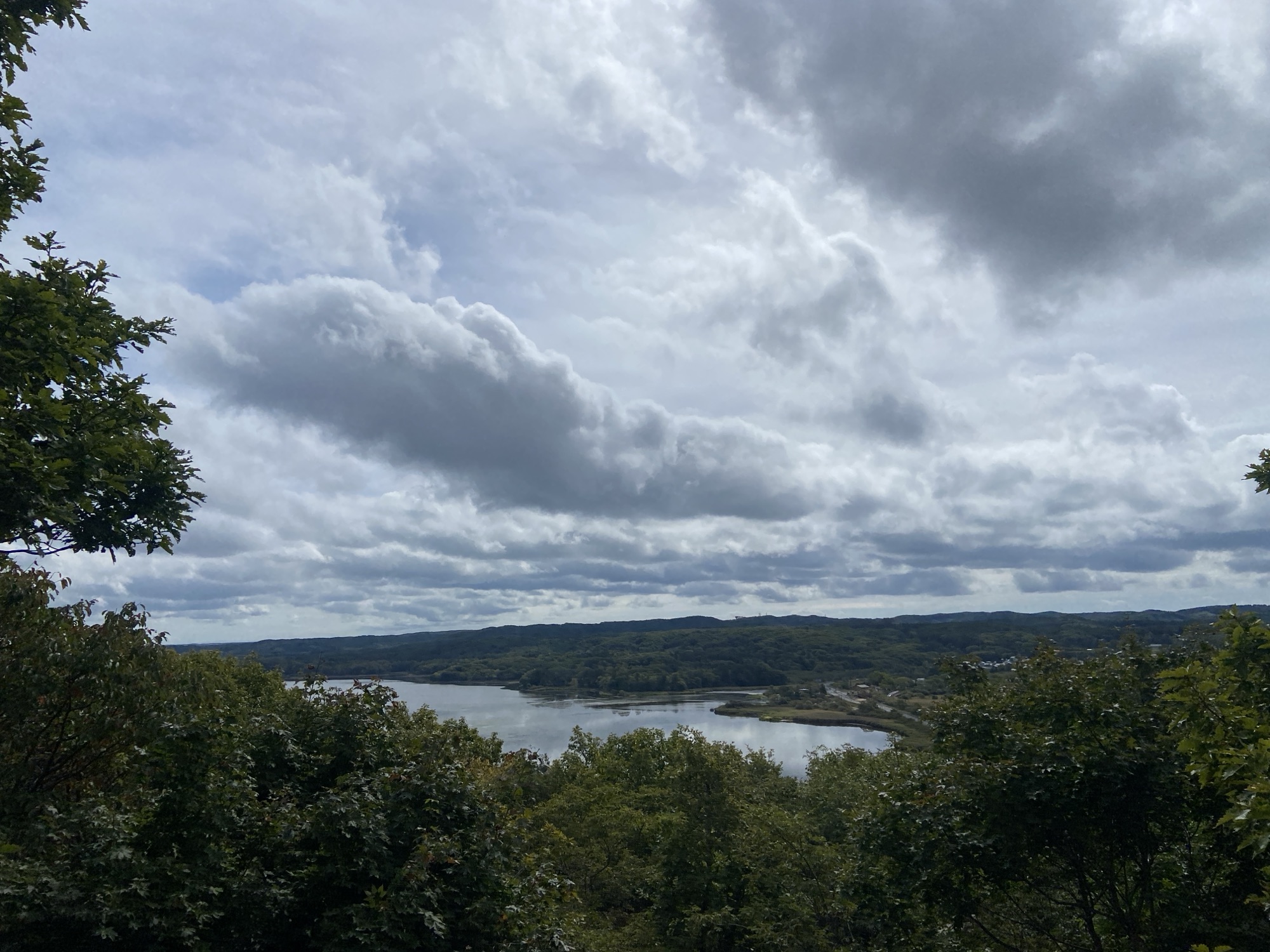
From the bakery, we drove towards the Hosooka Observatory, one of the classic viewpoints over the Kushiro Wetlands.
The walk from the car park was easy enough. Our only concern was, honestly, whether we were going to meet a bear somewhere along the way. We did not.
And the view was worth it.
The Kushiro Wetlands can be difficult to understand when you are simply driving around them. It is enormous and remarkably horizontal, with the Kushiro River winding through the marshland rather than looking like a conventional river valley. The wetlands form the largest wetland area in Japan and are protected as Kushiro Shitsugen National Park. The park is also an important habitat for the red-crowned crane, or tancho.
The landscape also has a much older human story. The Ainu communities of the Kushiro region historically lived along the Kushiro River, and the river mouth was already an important centre of trade during the Edo period. The settlement that developed into modern Kushiro grew from this relationship between the river, the coast, fishing and trade.
So from the viewpoint, we were not simply looking at an empty stretch of grass and water. We were looking across a landscape that has shaped how people have lived in eastern Hokkaido for centuries.
Hosooka Observatory on Google Maps


After that, we drove towards the Sarubo and Sarurun viewpoints around Lake Toro.
We originally thought we would make it to the Sarurun Observatory, but it requires more walking, so in the end we settled for Sarubo Observatory. To be honest, the hike itself wasn’t particularly difficult. It was just difficult for us because we are clearly lacking a little exercise at the moment.


The official route has the two viewpoints connected through the forest, with Sarubo reached first and Sarurun further on. Sarurun gives a wider view of Lake Toro and several of the smaller lakes and ponds around it.
When we were leaving, another car arrived and they almost went down the wrong path. We stopped them and pointed out that the route was actually the other way.
There is a map at the car park.
So, a very simple tip: read the map before starting the walk. It will save you from wandering off in the wrong direction.
Sarubo & Sarurun Viewpoints on Google Maps
We then went towards Toro, stopping at the tourist information centre beside the lake. There wasn’t a huge amount going on when we were there, but it has plenty of space, so I can imagine it being quite useful if you need somewhere to sit down, take a short break or get information before continuing around the wetlands.


Lunch beside Lake Toro
By then we were ready for food, so we went to Pasta & Coffee Prezzemolo (プレッツェモーロ).
We ordered an oyster and mushroom garlic pasta, as well as a cod roe and squid pasta. The portions were generous and, while we did have to wait a little, the food was not bad at all. The service was friendly.
The restaurant is right around the Lake Toro area, so it makes a convenient lunch stop if you are exploring the viewpoints and wetlands by car. Local information also describes the restaurant as being on the shore of Lake Toro and particularly known for its oyster and mushroom pasta.
I think it is worth trying if you happen to be in the area.


A burger at Toro Station
After lunch, we went to Bob’s Burger, which had become known online after being featured by an influencer.
Luckily, there was nobody else there when we arrived, so they prepared my order incredibly quickly — probably about five minutes.
I ordered the cheese burger with the original sauce, which came as a set with fries and a drink.
And actually, I really liked it.
The owner was lovely, and the burger itself was really good. If you are visiting Toro, I would say it is worth trying, especially because the shop is literally just in front of JR Toro Station. Bob’s Burger is only about a minute from the station and is very much tied into the experience of visiting this part of the wetlands.


While we were there, I also took a photo of Toro Station to commemorate the fact that we had managed to miss the last Kushiro Shitsugen Norokko Train — which, unfortunately, had also been cancelled because of a malfunction.
That felt particularly appropriate because the Norokko is one of the classic ways of seeing this landscape without driving. The sightseeing train has been running between Kushiro and Toro since 1989, giving passengers views of parts of the wetland that are difficult to experience from the road. And, rather sadly for anyone travelling this year, 2026 is its final year of operation after 37 years.
So missing it was a little unfortunate.
But at least we got the burger.
Following the Kushiro River into the wetlands
It was only around 1pm, so we still had a lot of day left.
Instead of heading straight back to Kushiro, we decided to drive to the Akan International Crane Center.
This turned into one of the more unexpectedly enjoyable drives of the trip.
Our GPS sent us onto a gravel road that ran alongside the Kushiro River, before cutting through the wetland landscape. The Kushiro River is the principal river flowing through the Kushiro Wetlands. It is about 154 kilometres long, beginning at Lake Kussharo and eventually reaching the Pacific Ocean at Kushiro. Its gentle gradient and relatively stable flow are part of what has helped shape the wetland environment.
The gravel road itself became part of the attraction.
We weren’t particularly in a hurry, and driving through that landscape gave us the feeling that we were seeing a much wilder side of Kushiro than we had seen in the city the previous day.
Then, almost as if the landscape wanted to reward us for taking that road, we encountered four wild red-crowned cranes and a fox while driving towards the crane centre.
Four wild cranes.

That was quite something.
The red-crowned crane is one of the defining animals of eastern Hokkaido. At one point, the species was thought to have disappeared from Japan, but a small group was rediscovered in the Kushiro Wetlands in 1924. Conservation and winter-feeding programmes have since helped the population recover substantially, and the crane is now protected as a Special Natural Monument of Japan.
So by the time we reached the crane centre, we already felt incredibly lucky.
Akan International Crane Center
The Akan International Crane Center (GRUS) was informative, and the staff were friendly.
We saw seven cranes there in total.
Normally, seeing seven cranes would probably feel like the highlight of the day, but after seeing four wild ones on the road, we had to admit that the earlier encounter had been especially fortunate.


The centre itself was established in 1996 and is dedicated specifically to the conservation and research of red-crowned cranes. It has exhibitions inside and outdoor areas where cranes can be observed throughout the year. During the colder months, artificial feeding attracts much larger numbers of wild cranes to the nearby feeding grounds.
This is one of those places where the history of conservation makes seeing the birds feel different. They are not simply beautiful birds to photograph; their presence in this region is connected to decades of habitat protection and conservation work.
Akan International Crane Center on Google Maps
A quiet afternoon before dinner
After the crane centre, we drove back towards Kushiro city.
We stopped at the Kushiro Waterworks Bureau to collect our manhole card, and there was some parking around the building, which made the stop quite straightforward.
Although it was barely 4pm, we decided to call it an early day.
We went back to the hotel, did some laundry and rested while waiting for our 9pm reservation at Robata.
As it turned out, that was a very good decision.
Not long after we got back, it started raining, and we really did not want to be driving around in the rain.
Finally understanding Kushiro’s food culture
We had originally asked our hotel to help us make a reservation, and they managed to get us into the original Robata restaurant, in Sakaemachi.
This was perhaps the point where Kushiro finally made sense to us.
The restaurant had exactly the kind of atmosphere I had expected from the word robata: a traditional charcoal hearth in the middle, with seating arranged around it. The fire becomes part of the room rather than something hidden away in a kitchen.
And there is a reason Kushiro is so closely associated with this style of cooking.
Robata-yaki is generally regarded as having originated in Kushiro in the 1950s. The story is closely connected to the city’s fishing culture: the idea of cooking food over charcoal was adapted to showcase the fresh seafood available in this major fishing port. By the late 1950s, the style had developed into a distinctive Kushiro food culture.
Kushiro’s fishing history goes much further back, of course. Fishing, kelp harvesting and trading were already important here by the Edo period, while the modern city later grew into one of Japan’s major fishing and port centres.
So sitting around that charcoal hearth, eating seafood that had been cooked directly over the fire, suddenly felt like a much better introduction to Kushiro than wandering through empty Sunday streets.


We ordered sablefish, shishamo, shiitake mushrooms, scallops, asparagus, potato and ochazuke.
Everything was just nicely grilled.
Not overdone, not complicated — just good ingredients, charcoal and careful cooking.
And I really loved the setting. The temperature was just right with the sliding door open. It wasn’t stuffy, but it wasn’t cold either, and the warmth from the charcoal hearth made the whole place feel incredibly cosy.
By the end of the meal, I think our opinion of Kushiro had changed quite a bit.
Maybe it wasn’t a sterile town after all.
Maybe we had simply been looking at the wrong side of it.
During the day, Kushiro was the wetlands, the winding river, gravel roads, wild cranes, foxes and enormous open skies.
At night, it was charcoal smoke, seafood, vegetables and people gathered around a fire.
That felt much closer to the Kushiro I had expected to find.
After dinner, we walked back to the hotel and called it a day.

Hosooka Observatory · Sarubo & Sarurun Viewpoints · Lake Toro · Bob’s Burger · Akan International Crane Center · Robata Kushiro
Transport & practical notes
If following this route by car, Hosooka → Sarubo/Sarurun → Toro → Akan International Crane Center → Kushiro works naturally as a full-day eastern Hokkaido itinerary. The Sarubo/Sarurun trail is free, but the viewpoints involve an uphill forest walk; official information gives roughly 20–30 minutes to Sarurun from the parking area, while other official information describes Sarubo first and Sarurun further beyond it.
For the Kushiro Shitsugen Norokko Train, 2026 is particularly important: JR Hokkaido says this is its final operating year. The Kushiro–Toro journey requires a basic fare plus a reserved-seat ticket, with the 2026 published one-way fares listed as ¥680 for the basic fare and ¥1,000 for the reserved seat. All seats are reserved, so it is not a train to simply turn up and board without the required reservation.
For Robata, the original restaurant is at 3-1 Sakaemachi, Kushiro, and its official site says reservations are accepted by telephone during opening hours. Since you used the hotel to secure the reservation, I would keep that practical detail in the article — it is genuinely useful for other travellers. (robata.cc)


Leave a Reply