
Dec 2024

Ever since I first saw pictures of the 客家土楼 (Hakka Tulou), I knew I had to visit one day. These massive circular fortresses looked like something out of legend—part village, part castle. The desire to see them grew even stronger because I am also Hakka by ancestry. I found myself wondering: did my own ancestors once live in houses like these, gathering in the courtyard, sharing meals, and facing the world together behind earthen walls?
A Living Heritage
The Hakka people are known as “客家” (literally, “guest families”), because they were migrants who moved southward from northern China centuries ago. To protect themselves in often unfamiliar and sometimes hostile environments, they developed a unique way of living—building large, fortified, communal houses that could accommodate dozens of families.
The Tulou, most famously concentrated in Fujian (though also found in Guangdong and Jiangxi), began appearing as early as the 12th century, with most of the existing ones built between the 14th and 20th centuries. UNESCO inscribed 46 Fujian Tulou as World Heritage in 2008, recognizing them as outstanding examples of traditional housing that reflect both community spirit and defensive strategy.
From the outside, a Tulou looks almost austere: thick walls of rammed earth, rising up like a fortress against mountains and bandits alike. But inside, it reveals an entirely different world: ring-shaped galleries, wooden balconies, ancestral halls, and kitchens where life revolved around family and cooperation.
Zhangzhou Tulou
Because transportation in the mountains isn’t easy, I joined a local tour. Our guide, a cheerful lady who had grown up in a Tulou, filled the trip with vivid stories: how families once shared kitchens, how festivals brought the whole Tulou together, and how life changed as people slowly moved away.

Our journey started at Yunshuiyao Ancient Town (云水谣古镇), with its ancient banyan trees mirrored in the river. The atmosphere was calm, like stepping into another time.
At the Tulou Light Cultural Park (土楼之光文化园), I got an overview of Tulou history and design. The visit helped me understand how these were not only homes but also fortresses and communities.
Huaiyuan Tulou(怀远楼) impressed me with its elegant design—perfect symmetry, a sense of quiet dignity.
Guihe Tulou(贵和楼) was different: square instead of round. One of its owners had once been an official, so the house was built slightly larger, with taller walkways. Yet when I compared it to my own home today, I realized—even their “大房” wasn’t half the size of mine. In that moment, I felt an unexpected sense of how fortunate our lives are now compared to the past.
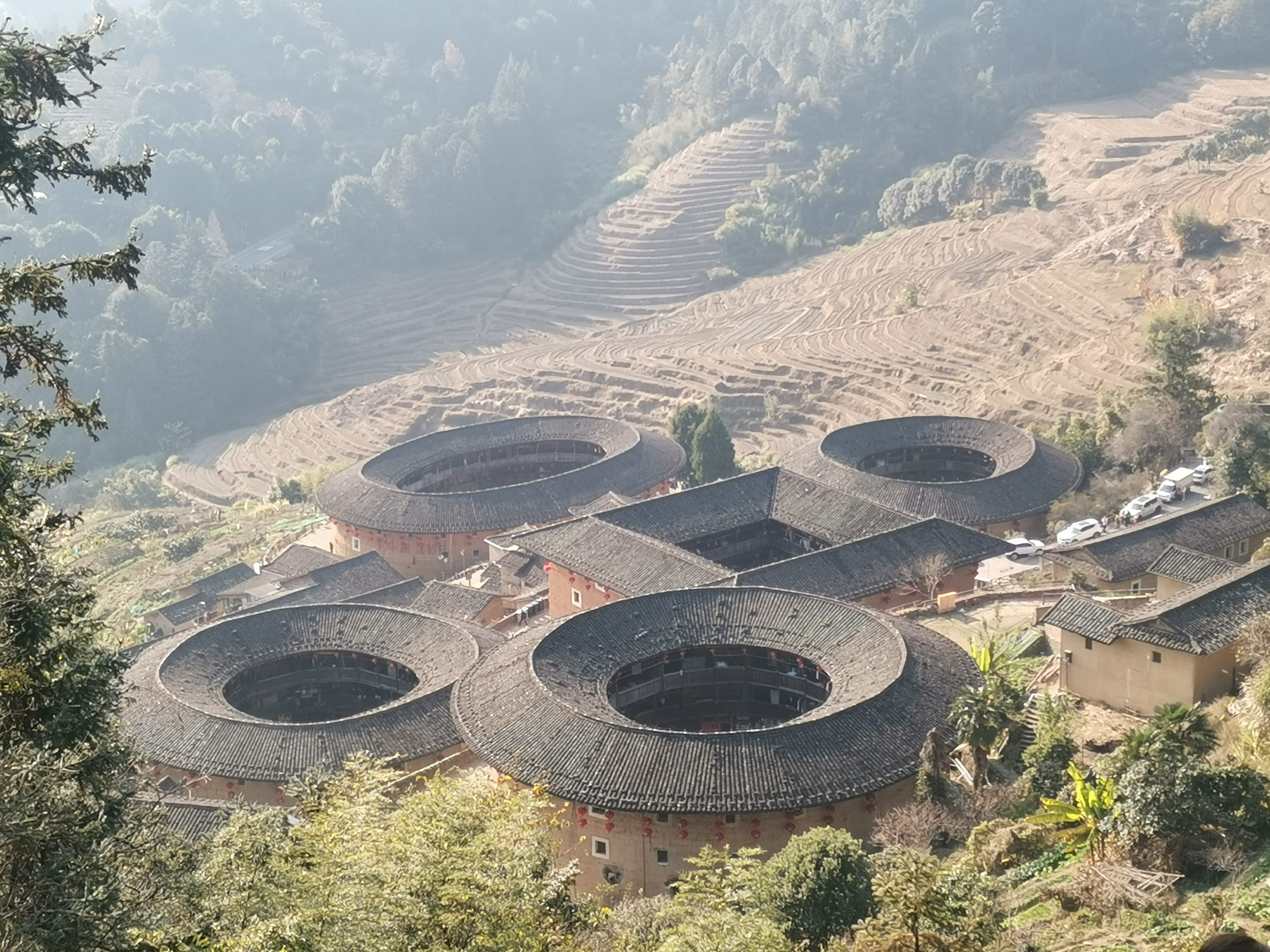
From a distance, we paused at a viewpoint for a cluster of tulou buildings The clusters of earthen fortresses nestled in misty hills looked like something out of a painting.


At Yuchang Tulou(裕昌楼), also known as the “leaning Tulou,” I marveled at how it has survived for centuries despite its tilted structure.
Our guide also shared darker tales. Once, a Tulou was besieged by bandits. Unable to break in, they launched flaming arrows, setting the wooden structure ablaze. Over a hundred lives were lost inside. The story was chilling—a reminder that while Tulou were eco-friendly and strong, their wooden interiors also carried risks.
What I Didn’t Do—but You Could
Although I didn’t stay overnight, some Tulou are open for lodging, offering a chance to wake up inside these earthen walls. Imagine hearing roosters at dawn, sipping tea in the courtyard, and watching the morning mist roll over the hills.
I also didn’t get the chance to share a home-cooked Hakka meal inside a Tulou—but travelers can. Many host families welcome guests with specialties like braised pork belly with preserved mustard greens or simple soups flavored with ginger.
For me, even a day visit was rich enough in atmosphere and history—but if you want to immerse yourself more deeply, staying a night is definitely worth considering.
Personal Reflections
As my guide spoke about her childhood in a Tulou, I thought of my own roots, and I couldn’t help but wonder: did my ancestors once live in places like these? Did they walk these same courtyards, share meals, and gather during festivals?
The Tulou felt less like historic relics and more like a living link to the past—a reminder of resilience, community, and belonging.
For me, this was more than sightseeing. It was a kind of homecoming. I may never know if my ancestors lived in such houses, but walking those earthen corridors made me feel a connection—fragile yet undeniable—to the resilience and unity that shaped Hakka life.
Visiting in winter gave everything a hushed, reflective mood. The mist softened the outlines, the air was cool and crisp, and the crowds were few. It was as if the Tulou were sharing their stories just with me.
Final Thoughts
The Tulou are more than architectural marvels. They are living symbols of survival, creativity, and identity. For me, visiting them was not only about admiring their form, but also about rediscovering my roots.


Leave a Reply