
25 November 2026
After our other travel companions left, we decided to spend the day exploring Shuri Castle in Naha.
We drove there, and the journey itself was surprisingly smooth. What we had not expected was how popular the area would be. Finding a parking space was more difficult than we anticipated, so eventually we left the car at a parking lot a little downhill from the castle and walked up.
In hindsight, it worked out rather well. Just opposite the parking lot was a textile shop, so we wandered in and had a good look around before continuing towards the castle.

Walking into the history of the Ryukyu Kingdom
Before going up, we stopped at the tourist information centre and picked up a manhole card, one of those small things we had started looking out for during our time in Japan.
Then we began walking towards Shuri Castle.
Shuri Castle is much more than an old Japanese castle. It was the political, diplomatic and cultural centre of the Ryukyu Kingdom, which existed as a unified kingdom from 1429 until its incorporation into Japan in 1879. For roughly 450 years, the castle was the residence of the Ryukyuan kings as well as the centre of government. (Oki Park)


The history of the kingdom is particularly interesting because Okinawa developed within a very different geographical and political environment from mainland Japan. Sitting between Japan, China and Southeast Asia, the Ryukyu Kingdom became an important maritime trading centre. Its culture absorbed influences from China, Japan, Korea and Southeast Asia without simply becoming a copy of any of them. UNESCO’s World Heritage designation specifically recognises this distinctive cultural development and the islands’ role as a centre of international exchange. (UNESCO World Heritage Centre)
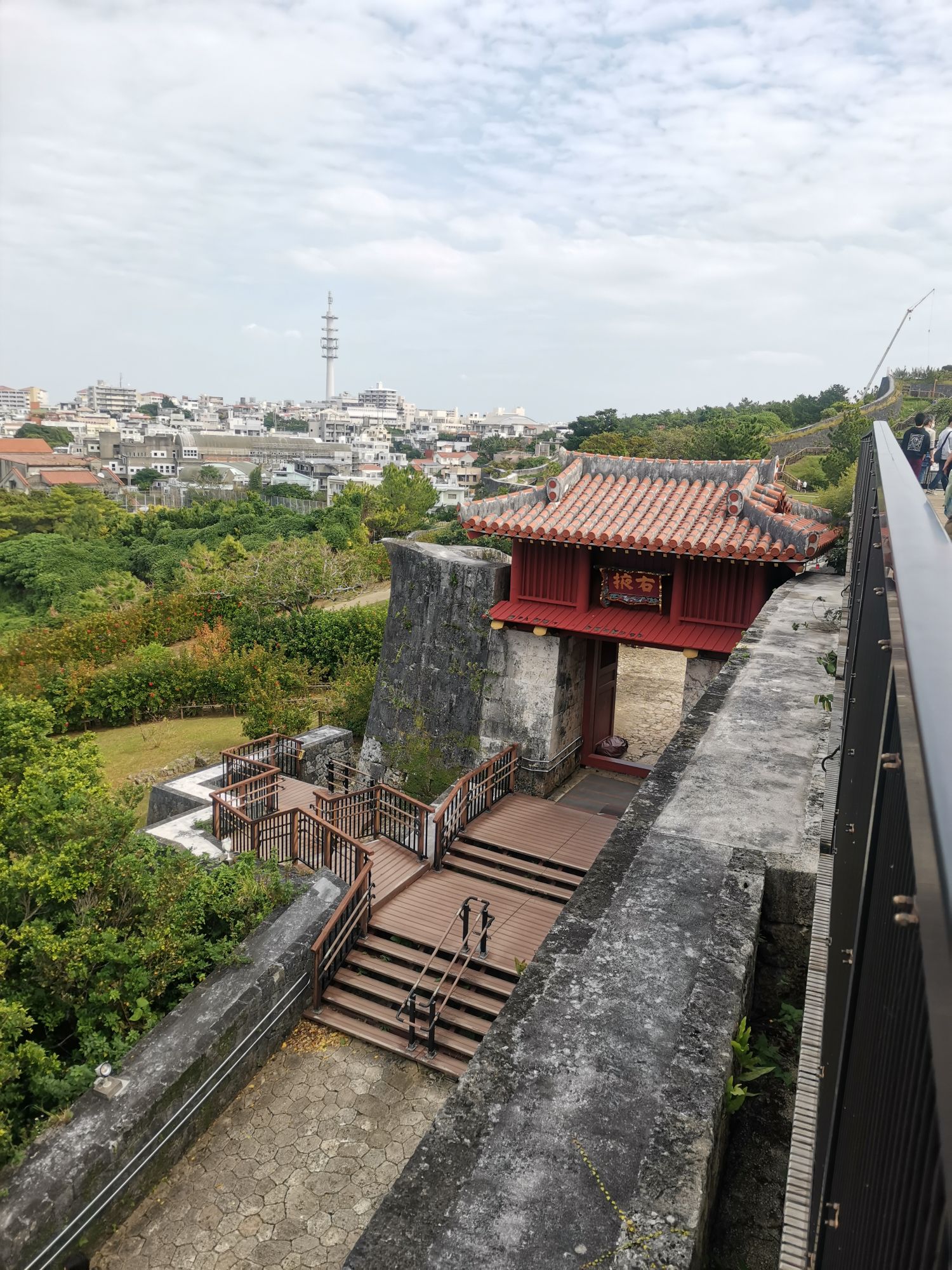
That mixture is visible in Shuri itself. The castle’s architecture combines Chinese and Japanese influences with distinctly Ryukyuan elements, while the curved stone walls, red-tiled roofs and sacred spaces give the complex a character quite different from the castles we had visited elsewhere in Japan. (Oki Park)
The approach itself was part of the experience.
Once we stepped onto the castle grounds, everything seemed to slow down. The path, stone walls, greenery and elevated position opened up views across Naha, while the bustle of the city gradually felt further away.
After several days of moving around the city, it was a surprisingly peaceful change of pace.
The castle was still under reconstruction
There is an important detail about our visit: we were there on 25 November 2025, when Shuri Castle was still undergoing major reconstruction following the 2019 fire.
The fire of 31 October 2019 destroyed or severely damaged several of the castle’s reconstructed buildings, including the Seiden, the main hall. This was particularly painful because Shuri Castle had already been destroyed during the Battle of Okinawa in 1945 and painstakingly reconstructed after the war. The Seiden and other major structures that existed before the 2019 fire were themselves reconstructions based on historical records, archaeological evidence, photographs and other documentation. (联合国教科文组织)
So when we visited, the actual castle buildings were not quite what we had imagined.
To be honest, there was relatively little to see architecturally inside because so much was still part of the reconstruction process.
But the staff had clearly tried to make the experience worthwhile. Instead of simply closing everything off, they put up information boards explaining what had happened and showing visitors aspects of the reconstruction process.
For us, though, the main attraction turned out not to be the building at all.
It was everything around it.
The castle grounds were the highlight
Walking along the old stone walls and through the grounds was genuinely enjoyable.
The elevated position gives Shuri Castle a completely different atmosphere from the busier parts of Naha. From the walls, we could look over the surrounding neighbourhoods, while closer to the castle there were trees, gardens, old stonework and quiet paths.
Something we noticed while walking around: the weathered limestone construction.

The walls of Shuri Castle are not simply straight defensive walls. Their curves follow the terrain, creating a softer, almost organic appearance. Okinawan gusuku — castle or fortified sites — are particularly known for this kind of stonework, with walls built from local limestone and shaped around hills and natural contours. The castle’s position on a hill was practical, but the resulting landscape is also one of the things that makes walking around Shuri so pleasant.
And Shuri Castle was not purely a military fortress.
It was a royal residence, government centre, cultural centre and an important religious space. Sacred areas were incorporated into the castle grounds, reflecting the importance of Ryukyuan religious traditions alongside political life. (Oki Park)
That helped explain why the atmosphere felt different from some of the Japanese castles we had visited elsewhere.
So, was it worth visiting?
Absolutely.
Did we see a lot of castle architecture?
Not really — at least not during our visit in November 2025.
Did I regret going?
Not one bit.
The castle grounds and gardens had a peaceful quality that washed over both of us as we walked around. After several busy days, we enjoyed simply wandering, looking at the stone walls, taking in the views and enjoying the slower pace.
In fact, Shuri Castle became one of the highlights of our time in Naha — not because of the castle building itself, but because of everything surrounding it.
There is also something quite meaningful about seeing the site while it is being rebuilt. Shuri Castle has burned and been rebuilt several times throughout its history. It was destroyed by fire during the Ryukyu Kingdom period, destroyed again during the Battle of Okinawa in 1945, reconstructed in the post-war period, and then badly damaged by the 2019 fire. The reconstruction is therefore not an unusual interruption in the story of Shuri Castle; rebuilding has become part of its much longer history. (Oki Park)
The site was inscribed as part of the “Gusuku Sites and Related Properties of the Kingdom of Ryukyu” UNESCO World Heritage property in 2000, together with eight other related sites in Okinawa. (Oki Park)
Taking our time back down into Shuri
After spending time around the castle, we slowly walked back down towards the surrounding streets.


Rather than rushing off to another attraction, we stopped at a local soba shop, had a nice coffee, and eventually returned to the hotel for a good rest.
It was one of those afternoons where we did not actually need to accomplish very much.
The walk itself was enough.
An izakaya evening around Kokusai-dori


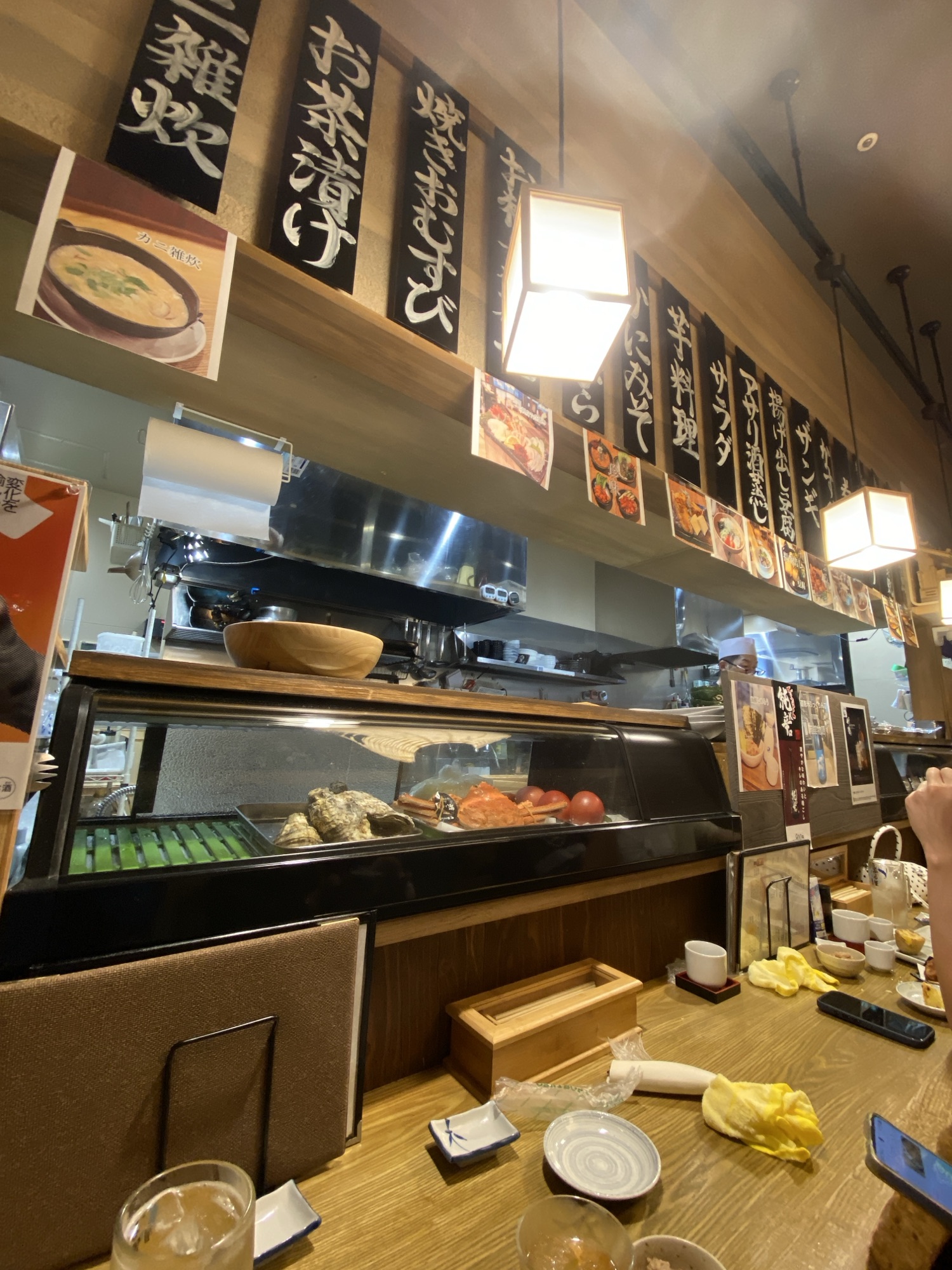
At night, we headed back towards Kokusai-dori, Naha’s famous shopping and entertainment street, and stopped at an izakaya.
Perhaps we went a little early, because although we had seen reviews suggesting that reservations might be necessary, the place was surprisingly quiet when we arrived.
The service was very friendly, the food was good, and we had a genuinely enjoyable evening.
To be honest, I had completely forgotten which izakaya it was by the time I wrote this. After going back through the places marked on my Google Maps, however, I believe this is probably the one:
Our Google Maps pin for the izakaya we believe we visited
I would treat that location as our best recollection rather than a definite identification, since I am reconstructing the evening from our map markings rather than from the original receipt or booking.
After dinner, we walked around the Kokusai-dori area for a while before heading back to rest.
It was a fairly ordinary Naha evening — and perhaps that was exactly why we enjoyed it.
A little history behind Shuri Castle
For readers who want a little more context, Shuri Castle’s importance becomes clearer when viewed as part of the history of the Ryukyu Kingdom, rather than simply as another castle in Japan.
The unified Ryukyu Kingdom was established in 1429, after the political unification of the three major powers on Okinawa. Under the Second Sho Dynasty, particularly during the reign of King Sho Shin, the kingdom experienced a long period of political stability and expanded its trade and cultural connections.
Shuri Castle became the centre of that world.
The kingdom maintained particularly strong relationships with China while also trading with Japan and Southeast Asia. This international position influenced everything from court ceremonies and architecture to clothing, language, food and the arts. Shuri consequently developed into a sophisticated political and cultural centre rather than simply a fortified stronghold. (Oki Park)
In 1879, the Ryukyu Kingdom was abolished and Okinawa became a prefecture of Japan. Shuri Castle subsequently had several different uses, including as a military facility and school. During the Battle of Okinawa in 1945, the castle was destroyed. The site later became a campus of the University of the Ryukyus before restoration began. Shuri Castle Park opened partially to the public in 1992. (Oki Park)
The site’s UNESCO status therefore recognises not simply a reconstructed red palace, but a much wider cultural landscape containing archaeological remains, castle walls, sacred sites and other historic structures associated with the Ryukyu Kingdom. (UNESCO World Heritage Centre)
Visiting note
For our November 2025 visit, the reconstruction was a major part of the experience.
If you are reading this later, check the official Shurijo Castle website before going because the situation is changing. The reconstructed Seiden is scheduled to reopen to the public on 23 November 2026, with advance reservations required for entry inside the Seiden itself. Other paid areas do not require that advance reservation. (Oki Park)
For drivers, parking at Shurijo Castle can be limited. The official site specifically advises visitors to use nearby private car parks when the main parking area is full — which is essentially what happened to us. The official parking information currently lists compact-car parking at ¥400, although rates and arrangements can change. (Oki Park)
The castle is also on a hill, with steps, slopes and stone-paved paths, so comfortable shoes are worthwhile. (Oki Park)
Location: Shurijo Castle Park, 1-2 Kinjo-cho, Shuri, Naha City, Okinawa
Japanese: 首里城公園
Google Maps: Shurijo Castle Park on Google Maps




Leave a Reply