
15 December 2025
We flew from Madrid to Porto on a short, uneventful flight — the kind that barely registers as a journey. Still, we were quietly anxious. Our experience entering Madrid had involved long lines and frayed patience, and with news of a possible strike circulating around this period, we braced ourselves for something similar.

Instead, Porto surprised us. Immigration was quick, efficient, almost effortless. It felt like the city was already gently contradicting our expectations before we had even stepped outside.
We booked a Bolt from the airport into the city. The ride took a little while, but the driver immediately put us at ease. This was our first time in Portugal, and perhaps sensing that, he became our unofficial welcome committee — pointing out landmarks along the way, sharing safety tips, and casually introducing us to the city as if he were showing a friend around rather than transporting tourists. That warmth stayed with me. It was my first, very human encounter with Portuguese hospitality.
A Rainy First Impression
By the time we arrived in Porto, it was raining — steadily, persistently, and without drama. In fact, it would rain the entire day. After checking in and resting briefly, we decided to head out anyway. I always feel that walking, especially on the first day, is the best way to understand a city’s rhythm, even if the weather is less than ideal.

Our first stop was the tourist information centre, though it turned out to be a slightly puzzling experience. I remember travelling in Europe twenty years ago: walking into these centres, picking up a city map, and being guided enthusiastically toward must-see attractions. This time, the information felt… thinner.
They weren’t unhelpful — just less informative than I remembered. I found myself wondering why. Is it the internet, which has made these centres less necessary? Have they gradually shifted away from being storytellers and planners? Or is it simply me — older now, expecting deeper context, more background, more meaning than before? Maybe it was always like this, and only my expectations have changed. I couldn’t quite decide.
A Beautiful McDonald’s and a Practical Lunch
We left the centre and walked toward what is often called “the most beautiful McDonald’s in the world.” Housed in the former Café Imperial, the building dates back to the 1930s and reflects Porto’s Art Deco period, a time when the city was asserting a more cosmopolitan identity. When McDonald’s took over the space, strict preservation rules limited alterations, allowing stained glass windows, chandeliers, and ornate detailing to remain.
For us, it wasn’t about the title or novelty. We were simply hungry, tired, and short on patience to hunt for food in the rain. It doubled as a practical lunch stop — warm, dry, and oddly atmospheric.

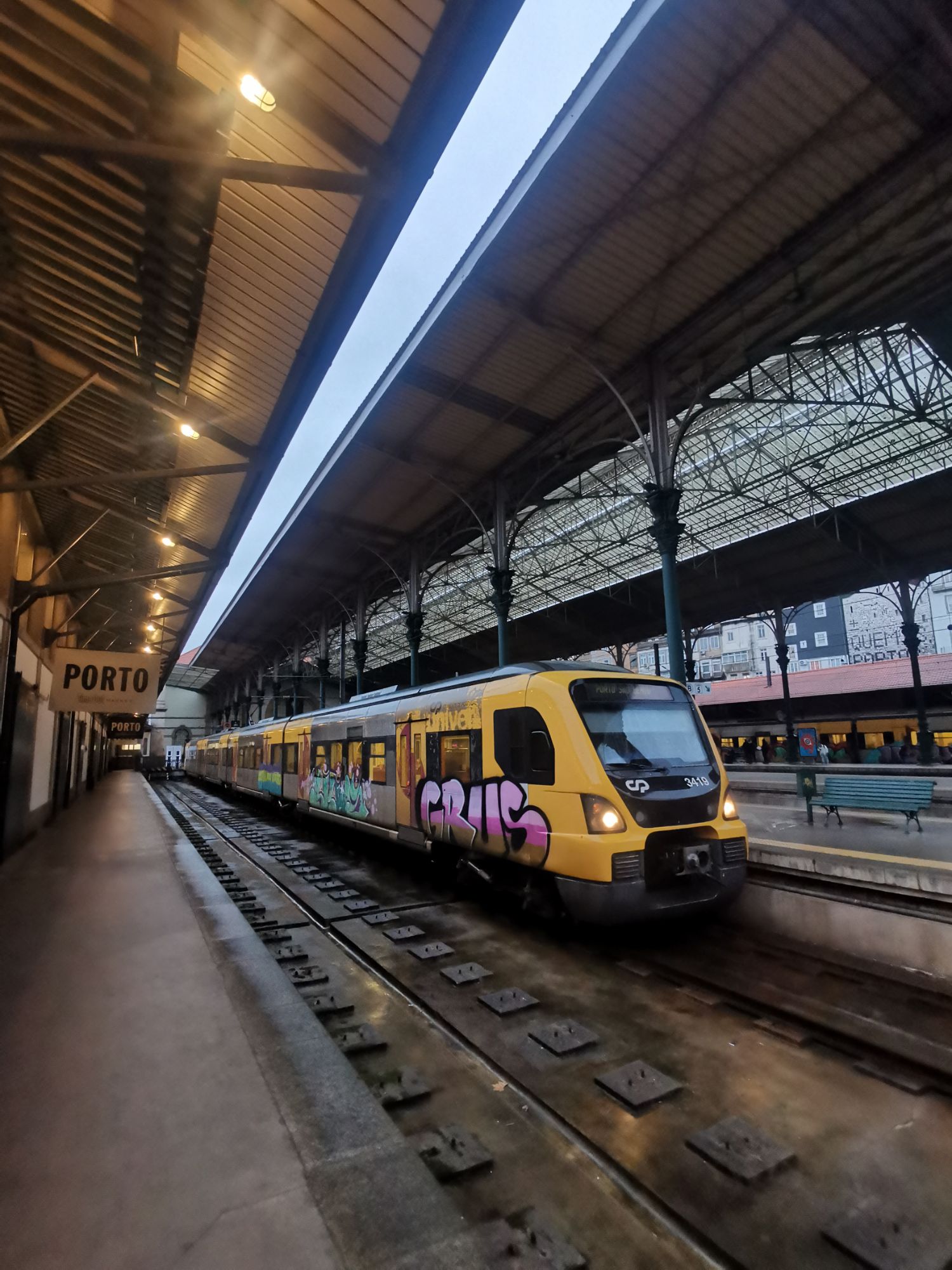
Just nearby stood São Bento Railway Station, one of Porto’s most celebrated landmarks. Opened in 1916 on the site of a former Benedictine monastery, the station is famed for its vast collection of azulejo tiles — over 20,000 hand-painted ceramic panels lining the main hall. These blue-and-white scenes depict key moments in Portuguese history: royal ceremonies, rural life, battles, and the evolution of transportation. Azulejos are deeply embedded in Portuguese culture, serving not just as decoration but as a visual record of collective memory. Standing there, watching travellers pass beneath centuries of painted history, felt quietly grounding.


Waiting Out the Rain (and a Footwear Lesson)
After that, we decided it was best to return and rest, waiting for the rain to subside. Which we did.
A small but important lesson emerged here. I’ve never paid much attention to shoes, but if you’re travelling — especially in winter — waterproof footwear really matters. My friend’s shoes handled the rain just fine; mine did not. By the time we got back, my feet were partly soaked, which is far from ideal when temperatures are low. It’s a minor detail, but one that can affect your entire day.
Night Walks, Dark Streets, and the Douro
By nightfall, the rain finally stopped. We decided to head out again, this time toward the Ribeira riverfront.

Following Google Maps, we found ourselves walking uphill along a very dark street. Two men stood there, lingering in the shadows. We told ourselves to stay calm and keep walking, which we did. Nothing happened. Later, we learned that the area was known for drug dealing. Perhaps we were simply unlucky with the route — or overly sensitive to the darkness — but it reinforced the importance of sticking to main streets whenever possible.

Soon after, we reached the Dom Luís I Bridge, and the atmosphere changed completely. The bridge, completed in 1886 by a student of Gustave Eiffel, rises dramatically above the Douro River. Walking across the upper deck at night was unexpectedly romantic. The bridge is shared by pedestrians and the metro, so when the train approaches, people instinctively move aside to let it pass — a small, oddly charming moment of collective choreography.

From above, we could see the monastery across the river, the illuminated Ribeira district below, and the reflections of city lights shimmering on the water. Crossing to the Gaia side, we passed by the famous port wine lodges — closed at this hour — before descending and crossing back on the lower deck.
We didn’t feel particularly unsafe at the time. There weren’t many people around, but we did pass a few other tourists. A few weeks later, though, we saw posts on social media about a robbery nearby. Sometimes, safety really is a mix of awareness and luck. In retrospect, despite our caution, we were probably taking some risks.
A Quiet Riverfront Ending
Back on Porto’s side, a row of restaurants lined the riverfront. They were mostly empty. I imagined how different this place must feel during peak season, when tables spill onto the promenade and the river buzzes with life. That night, everything was subdued and calm.

We walked along the Douro for a while, then slowly made our way back uphill to our accommodation. And that was our first day in Porto — shaped not by grand plans, but by rain, small conversations, quiet doubts, and the slow process of getting to know a city.


Transport Tip
Taxis in Portugal are not particularly expensive, especially if you’re travelling with others. Ride-hailing apps like Bolt or Uber are convenient options, particularly in bad weather or at night

Leave a Reply