
Madrid: A Return to the Soul of Spain
14 December 2025
Returning to a city after twenty years is like meeting an old friend whose face you’ve partially forgotten, but whose warmth you still feel. My last encounter with Madrid was two decades ago—a blur of ornate “shell rooms” in the Royal Palace and the kindness of strangers. I remember an elderly lady tirelessly navigating the Metro with me, and a local man giving me enthusiastic directions in Spanish while I nodded, not understanding a single word but feeling entirely welcome.
Twenty years later, the language barrier remains a charming hurdle, but with a bit of Duolingo and a translator app, the “broken Spanish” conversations have become part of the adventure. Madrid hasn’t lost its heart; it remains a city defined by its people.
The Tale of Two Bridges

After a quick breakfast at Santagloria—a reliable staple for a café con leche—we began our day at the Puente de Toledo.


Historical Context: This stunning Baroque bridge, completed in 1732, was designed by Pedro de Ribera. It features nine arches and statues of Madrid’s patron saints, San Isidro and Santa María de la Cabeza. It stands as a testament to the city’s imperial past, once serving as a grand entrance for those traveling from Andalusia.
Contrasting this is the neighboring Arganzuela Footbridge, a futuristic, spiraling metallic ribbon designed by Dominique Perrault. Seeing them side-by-side is a perfect visual metaphor for Madrid: a city that honors its history while spiraling boldly into the modern age.
Retiro: The Lungs of the Monarchy
We utilized our 10-trip transit card—a budget-saver for any traveler—to reach El Retiro Park. Even in the slumber of winter, the park pulses with life. Joggers, dog-walkers, and cyclists fill the pathways that were once the exclusive playground of the Spanish monarchy.


The park was originally created as a royal retreat for King Felipe IV in the 17th century. Today, it is a UNESCO World Heritage site. While the vegetation was sparse in December, the sight of the locals enjoying their “Sunday ritual” made the vast gardens feel incredibly vibrant.
From Post Office to Palace: Palacio de Cibeles
Our wandering led us to the Cibeles Palace. With its cathedral-like white towers, it’s easy to mistake it for a royal residence. It actually served as the city’s main post office (Palacio de Comunicaciones) until 2007, when it became the City Hall.
We skipped the exhibitions but made use of the excellent tourist information center inside. It’s a great hack for travelers: the building is free to enter (after a quick security check), and the staff are incredibly helpful with local tips.
Square Hopping: Sol and Gran Vía
Following a tip, we hunted down some festive churros. While they were good, my heart (and stomach) still belongs to the porras of Toledo—thicker, fluffier, and perhaps more soulful.

We headed to Puerta del Sol, the symbolic center of Spain. In a fun modern twist, the square was taken over by a Stranger Things promotion, with Metro signs flipped “Upside Down.” We then walked the Gran Vía, Madrid’s “Broadway,” towards the historic Plaza Mayor.
Culture Note: Plaza Mayor has seen everything from royal weddings to public executions and bullfights. Today, it hosts the annual Christmas Market. While the famous Mercado de San Miguel was overflowing with people seeking tapas, the energy of the crowd alone was enough to soak in the holiday spirit.


A Sunset at the Temple of Debod


We opted to admire the Royal Palace and the Almudena Cathedral from the outside. Having visited the palace twenty years ago, and traveling on a budget this time, we focused on the views rather than the entrance fees.

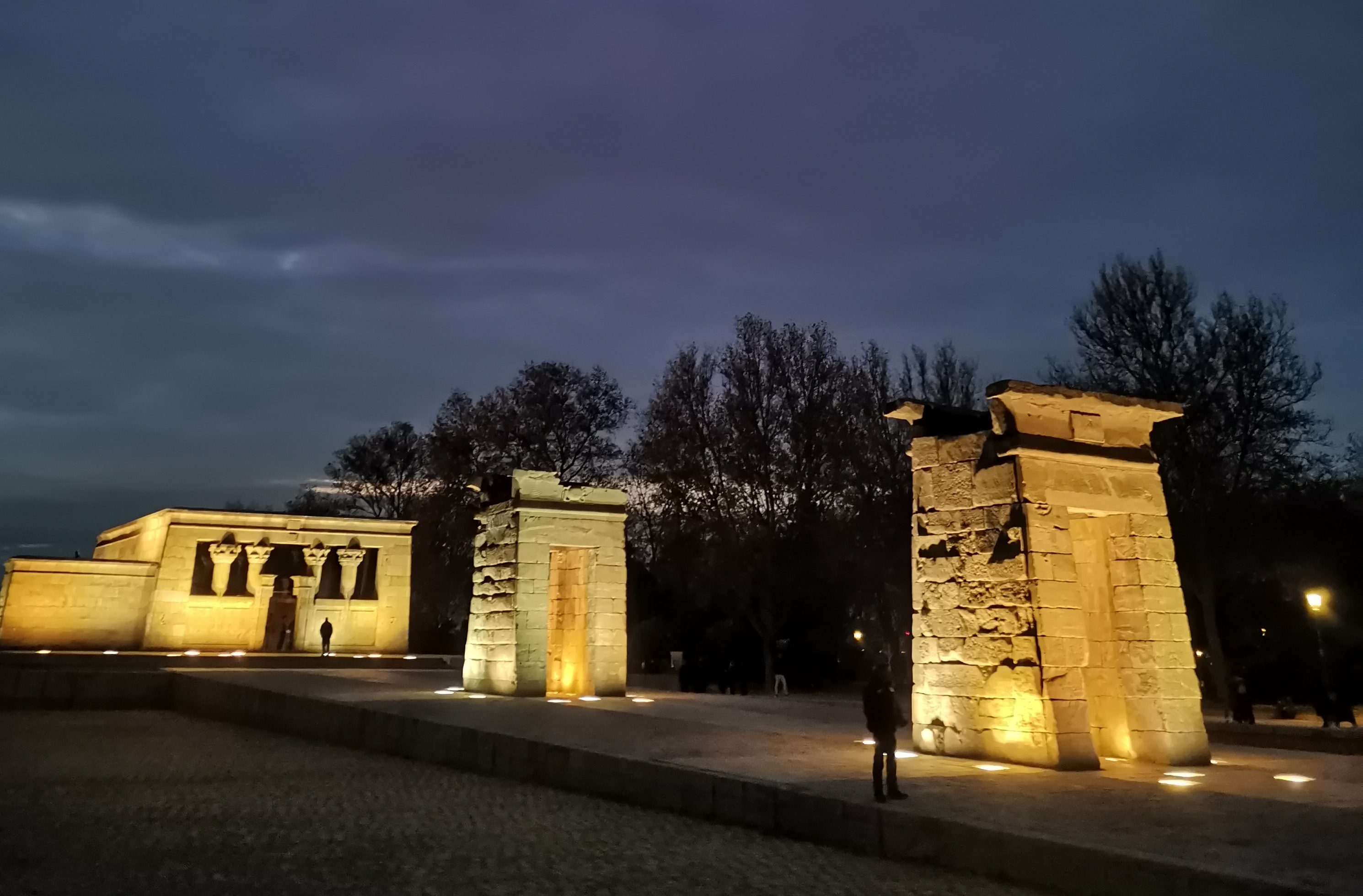
The highlight of the late afternoon was the Temple of Debod.

- The History: This is an authentic 2nd-century BC Egyptian temple, gifted to Spain in 1968 as a thank-you for helping save the Abu Simbel temples from flooding.
- Travel Tip: Entry to the interior is free, but you must reserve online. Slots open every half hour and vanish quickly. Even if you don’t go inside, the park offers one of the most breathtaking panoramic views of the city and the Royal Palace at sunset.
The Mercado Lesson: Timing is Everything
After our long trek across the city heights and the tranquil sunset at Debod, we decided to give the Mercado de San Miguel one last chance. Earlier in the afternoon, it had been a wall of people—an overwhelming sea of tourists and locals that made grabbing even a single olive feel like a mission.
Returning well after the lunch peak was a game-changer. The crowd had thinned significantly, allowing us to actually breathe and browse the stalls. We finally managed to tuck into some authentic tapas, savoring the flavors that make Madrid a global culinary capital.
Travel Lesson: If you want to experience the famous markets without the stress, avoid the peak lunch hours (2:00 PM – 4:00 PM). Returning in the “lull” before the late Spanish dinner rush allows you to actually see the food you’re ordering and find a corner to enjoy it.
We ended our night with a unique culinary find: Pistachio Spaghetti. A creamy, nutty, and modern end to a day spent revisiting the ghosts of trips past. Madrid, it was good to see you again.





Leave a Reply