

There is something wonderfully calming about Ishigaki Island. Unlike Okinawa’s bustling main island, life here seems to move at a gentler pace. Roads wind through sugarcane fields instead of city streets, emerald mountains rise in the distance, and the ocean is never far away. It is an island that encourages you to slow down, take the scenic route, and appreciate the little moments along the way.
After spending several days exploring Ishigaki’s dramatic coastline, today was dedicated to discovering another side of the island—its geological history, traditional Yaeyama culture, and comforting local cuisine.
Starting the Day with Local Yakisoba and Ishigaki Beef
Like many mornings on Ishigaki, our day began with food.
Instead of rushing off to the next attraction, we took our time driving through the island’s quiet countryside in search of a local favourite.
Rather than the familiar Japanese yakisoba found at festivals across mainland Japan, this restaurant served an island-style version that immediately stood out. The noodles were stir-fried until slightly smoky and generously topped with goat meat (山羊肉 / yaginiku)—something we don’t often come across back home.
Goat has long been part of Okinawan cuisine. Historically, the Ryukyu Islands had limited grazing land for cattle, and goats were easier to raise on the subtropical islands. They became an important source of protein, particularly after the devastation of the Second World War when food was scarce. Even today, goat dishes remain popular throughout Okinawa, although their strong, distinctive flavour tends to divide opinion.
This was actually my first time trying goat served this way. The meat had a richer, more robust flavour than beef, with a slight gaminess that paired surprisingly well with the savoury stir-fried noodles. It certainly wasn’t something I’d order every day, but travelling is all about experiencing local flavours, and this was one of those dishes that reminded us we were far from mainland Japan.


Alongside the yakisoba, we also ordered a bowl of Ishigaki beef noodles and a comforting Ishigaki beef rice. Ishigaki beef is one of Japan’s premium wagyu brands, prized for its fine marbling and rich flavour. While it may not enjoy the same international fame as Kobe or Matsusaka beef, locals know it as one of the island’s culinary treasures.
Between the smoky goat yakisoba, the tender slices of Ishigaki beef and the warm bowls of noodles and rice, breakfast turned into a little tasting session of the island’s local specialities—a delicious way to begin another day of exploring.
Into the Ancient Underground World of Ishigaki Limestone Cave
Our next destination took us far beneath the surface.
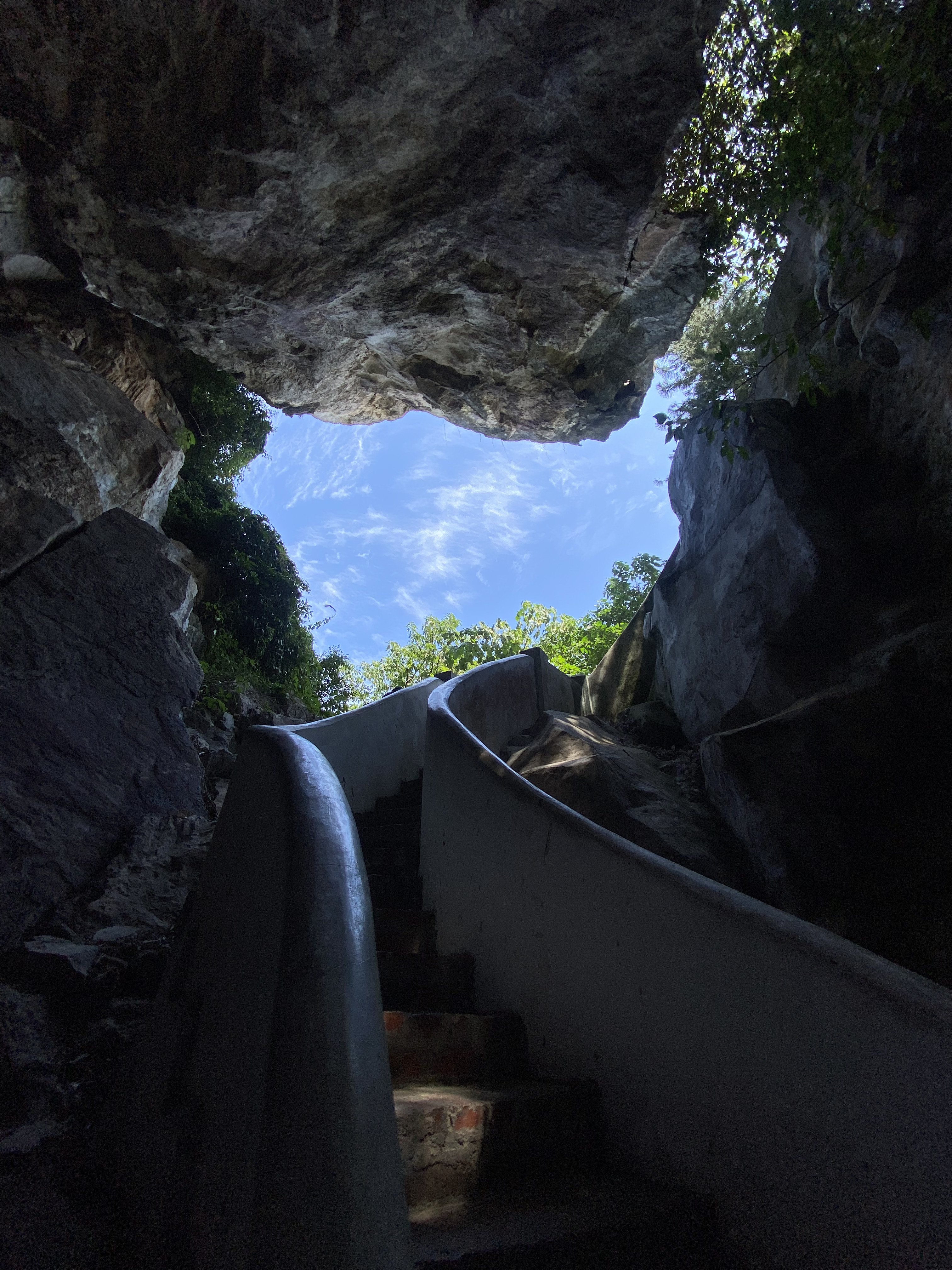
Located just a few minutes from Ishigaki City, Ishigaki Island Limestone Cave (石垣島鍾乳洞 / Ishigaki Shonyudo) is one of the island’s oldest natural attractions.
Unlike many limestone caves formed from inland mountains, Ishigaki’s cave has a rather unique origin.
Around 200,000 years ago, much of the Yaeyama Islands lay beneath warm tropical seas. Massive coral reefs slowly accumulated over thousands of years before tectonic uplift gradually pushed them above sea level. Rainwater, naturally acidic from absorbing carbon dioxide in the atmosphere, seeped into the porous limestone and slowly dissolved the rock, carving intricate chambers and passageways over countless millennia.
The result is a spectacular underground landscape stretching more than 3 kilometres, although visitors currently explore approximately 660 metres of accessible pathways.
Walking inside feels like stepping into another world.
Cool air instantly replaces Ishigaki’s tropical humidity.
Water droplets echo gently through the chambers.
Every turn reveals another incredible limestone formation sculpted by nature over thousands of generations.
Some resemble frozen waterfalls.
Others resemble giant curtains or cascading icicles suspended from the cave ceiling.


The cave is illuminated with colourful lighting, adding a slightly surreal atmosphere that highlights the incredible textures carved by time. While some visitors may prefer natural lighting, we found the colourful illumination created an almost dreamlike experience, especially deeper inside the cave where enormous stalactites tower overhead.
There are quite a few stairs and gentle climbs throughout the route, so comfortable shoes are definitely recommended. The pathways can also become slippery from constant moisture.
Despite the exercise, the naturally cool temperature makes it one of the most pleasant places to visit during Ishigaki’s hot summers.
Preserving the Spirit of the Yaeyama Islands
Leaving the underground world behind, we continued west towards Ishigaki Yaima Village (石垣やいま村).
At first glance, it might appear to be a simple cultural theme park.
In reality, it is one of the most important heritage sites on the island.
The Yaeyama Islands possess their own unique culture that differs noticeably from mainland Japan. Before Okinawa became part of Japan in the late nineteenth century, these islands formed part of the Ryukyu Kingdom, an independent maritime kingdom that flourished through trade with China, Korea and Southeast Asia for nearly 450 years.
Because of these trading connections, Yaeyama culture developed its own architecture, music, language and customs.


Rather than allowing traditional homes to disappear with modern development, many authentic houses from villages across the Yaeyama Islands were carefully dismantled, relocated and reconstructed inside Yaima Village.
Several of these buildings are recognised as Registered Tangible Cultural Properties of Japan, preserving architectural styles that would otherwise have gradually vanished.
Walking through the village almost feels like stepping back into the nineteenth century.
Red clay roof tiles.
Stone walls built to withstand powerful typhoons.
Shisa guardian lions watching over entrances.
Large wooden verandas where families once escaped the afternoon heat.
As we wandered through the village, the gentle melodies of the sanshin drifted across the gardens.
The sanshin—a three-stringed instrument covered with snakeskin—is often considered the soul of Okinawan music. Its soft, nostalgic sound perfectly matched the peaceful atmosphere, making it easy to imagine daily life here decades or even centuries ago.
The Squirrel Monkeys Steal the Show
For many visitors, however, history is only half the attraction.
The other stars of Yaima Village are undoubtedly the Bolivian squirrel monkeys.
More than sixty of these tiny monkeys live freely within a dedicated enclosure where visitors can walk among them.
Of course, we quickly discovered that the monkeys have personalities of their own.
There always seems to be that one lucky visitor who instantly becomes the monkeys’ favourite.
Within seconds, several monkeys were climbing onto their shoulders, balancing on their heads, and happily posing for photographs.
Meanwhile, the rest of us waited patiently, hoping we might become equally interesting.
Some monkeys approached cautiously.
Others simply glanced at us before deciding someone else looked more entertaining.
It was one of those wonderfully unpredictable experiences that made everyone laugh.
Rather than forcing interactions, the monkeys simply chose whoever they fancied that day.
Perhaps they have better judgement than we do.
Ending the Day at a Local Izakaya
After a full day of exploring, we returned to town for dinner.
One of the best parts of travelling around Japan is ending the day in a neighbourhood izakaya.
The atmosphere is always lively without feeling rushed.
Locals unwind after work.
Friends gather over drinks.
The aroma of charcoal-grilled skewers fills the room.
Our table gradually filled with plates of yakitori, grilled seafood, edamame and a few local Okinawan specialities while we reflected on everything we had seen throughout the day.


📍 Ishigaki Island Limestone Cave
Address: 1666 Ishigaki, Okinawa
Google Maps:
https://www.google.com/maps/search/?api=1&query=Ishigaki+Island+Limestone+Cave+1666+Ishigaki
Admission
- Adults: approximately ¥1,200
- Allow around 45–60 minutes
- Open daily (hours may vary seasonally)
Travel Tips
- Wear shoes with good grip as cave floors can be damp.
- The cave remains pleasantly cool year-round, making it an excellent rainy-day attraction.
- There are numerous stairs, so visitors with limited mobility should take extra care.
📍 Ishigaki Yaima Village
Address: 967-1 Nagura, Ishigaki
Google Maps:
https://www.google.com/maps/search/?api=1&query=Ishigaki+Yaima+Village+967-1+Nagura+Ishigaki
Admission
- Tickets available at the entrance or online through platforms such as Klook.
- Allow 1.5–2 hours to fully explore.
Travel Tips
- Check the schedule for traditional sanshin performances and cultural demonstrations.
- If visiting the squirrel monkeys, remove loose jewellery and securely store glasses or hats, as curious monkeys may try to grab them.
- Bring insect repellent during warmer months.
Getting Around Ishigaki Island
The easiest way to explore Ishigaki is by rental car.
Many of the island’s best attractions—including Kabira Bay, Yaima Village, Banna Park and the Limestone Cave—are spread across the island, making self-driving by far the most convenient option.
If you prefer public transport, Azuma Bus operates routes connecting Ishigaki Port Terminal with many major attractions. However, services are relatively infrequent compared to mainland Japan, so planning around the timetable is essential.
For visitors arriving by ferry from other Yaeyama islands such as Taketomi, Iriomote or Kohama, rental cars are readily available near Euglena Ishigaki Port Terminal, making it easy to continue exploring after disembarking.


Leave a Reply