
19 December 2025

Sintra is a place that feels plucked straight from a storybook. We recently took a day trip there, and even in the mid-December drizzle, the town held a certain moody magic. If you are a fan of history, architecture, or just want to feel like royalty for a day, Sintra is the highlight of any Portuguese itinerary.
The Logistics: Getting from Lisbon to Sintra
We started our morning by heading to the Sete Rios station. From our hotel, it was a quick trip using the Navegante card (€1.66). Once at Sete Rios, the train ticket to Sintra was a very affordable €2.00.
Pro Tip: Most tourists immediately flock to the 434 tourist bus upon arriving in Sintra. A one-day pass is €13, while a single trip is around €4. However, there’s a catch: the bus drivers usually only sell the full-day passes. If you only want a one-way ticket (to ride up and walk down like we did), you have to go to their physical ticket office.
In retrospect, if you are a group of two or more, check Bolt or Uber. You can often snag a ride for about €5 per person, or even haggle for a Tuk Tuk ride, which is much more fun!

Pena Palace: Colors in the Clouds
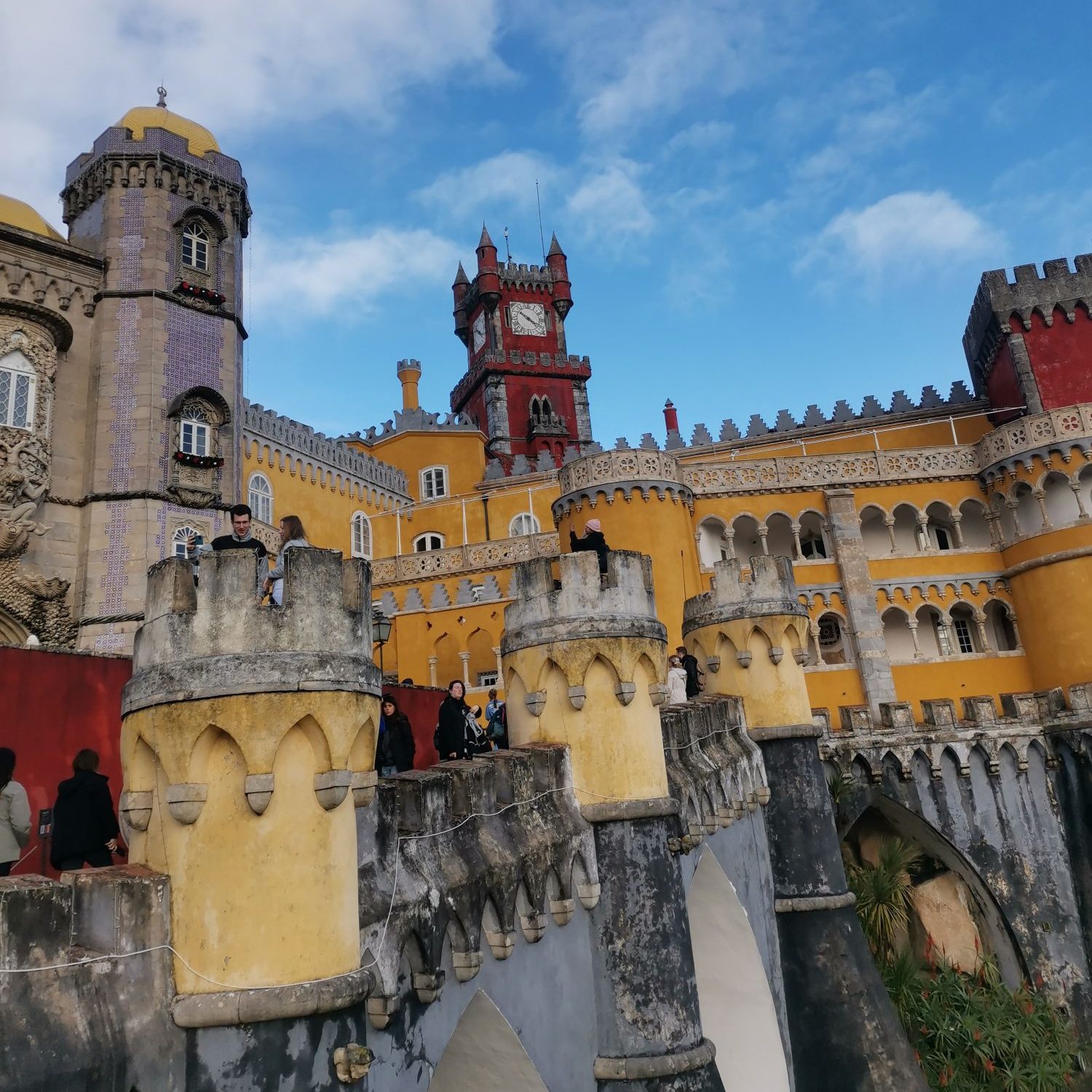
Pena Palace is the “Big One.” It’s a 19th-century Romanticist tribute to Portugal’s past.
Walking up through the misty park, the palace appeared like a neon dream. It was founded on a 16th-century monastery, but King Ferdinand II (the “Artist King”) reimagined it as a bold blend of Neo-Gothic, Manueline, and Islamic styles. He intentionally incorporated Mudéjar elements—a style developed by Muslims who remained in Christian-held territories—as a tribute to the diverse cultural layers that built Portugal. Look for the Great Tritons Porch, where Islamic tilework 🕌 meets Christian maritime carvings ⚓.
There are two ticket types: The Park or The Park + Palace. Trust me, buy the Palace ticket. It’s worth it.
The Timing: Tickets are for a 30-minute entry window. While people say you must book weeks in advance, we visited in winter and found plenty of availability the day before.


The Climb: It’s a bit of a walk from the park entrance to the palace itself. You can pay for a shuttle, but the walk is beautiful. It was drizzling and misty during our visit, giving the greenery a moody, ethereal feel.
Standing at the palace at 10:30 AM, the colors felt a bit muted by the gloom, but the architecture is still mind-blowing. As an adult, you can’t help but soak in the history, but if I were a child, I’d be obsessed with the staircases and hidden corners. It truly feels like a medieval fairytale—something we just don’t see back home in Southeast Asia.


The Long Walk Down: Moorish Castle to Town
Leaving the bright, eccentric colors of Pena behind, we hiked toward the rugged grey stone of the Moorish Castle. This isn’t a place built for beauty; it was built for surveillance. 👁️
As we walked the battlements, you could see how the Moors in the 8th century used the geography as a weapon. The walls don’t just sit on the mountain—they crawl along its jagged spine, designed to follow the natural ridges to make them nearly impossible to scale. You can still feel the weight of the Reconquista ⚔️ here. When King Afonso Henriques finally seized this height in 1147, he chose to keep these walls, but he added a Romanesque chapel within the fortress, physically layering a new faith over the old military stronghold.
We reached the entrance but decided to skip the interior—we weren’t quite in the mood for more stone walls just then. Instead, we took the footpath from the castle back down to the town center.
It was long, winding, and incredibly peaceful. By the time we hit the bottom, our legs were feeling it! I felt a surge of respect for the tourists we saw hiking up that path. If you want to save some strength, definitely take a vehicle up and walk down!


The Magic of Quinta da Regaleira
After a quick walk through the town square, we headed to Quinta da Regaleira. It’s about a 20-30 minute uphill walk from the center.
This place is massive—much more than just a house. It’s a sprawling estate filled with hidden tunnels, towers, and the famous Initiation Well.
The Initiation Well is a geographical anomaly—an “inverted tower” plunging 27 meters into the mossy limestone 🌍. Descending the spiral stairs, the air grows heavy and wet. The sound of water drilling down into the dark echoes strangely, creating a sense of profound isolation. This wasn’t for water; it was for secret rituals. Walking through the damp tunnels at the bottom feels like a spiritual journey from darkness back into the light 🕯️.
Historical Note: Quinta da Regaleira was designed to reflect the interests of its owner, Carvalho Monteiro, who was fascinated by alchemy, Masonry, and the Knights Templar. The well wasn’t for water; it was for ceremonial purposes, symbolizing a journey from darkness into light.
You could easily spend two hours here, but as “impatient travelers,” we marched on to the coast!


Chasing the Edge of the World: Cabo da Roca & Azenhas do Mar

We pushed our luck and headed to Cabo da Roca, the westernmost point of continental Europe. On the monument, the poet Luís de Camões wrote: “Where the land ends and the sea begins.” 🌊
It was incredibly windy and bleak in the winter light. To be honest, having seen the capes in Okinawa, this felt a bit stark, but there is still a thrill in standing at the “edge” of the continent.

For the explorers of the Age of Discovery, these cliffs were the last glimpse of home before sailing into the unknown.
We finished at Azenhas do Mar, a cliffside village where white-washed houses seem to grow out of the rock—a visual feast for photography. It seems to be a hit with Asian tourists—we saw several groups there. Despite the wind, we braced ourselves to capture the perfect sunset shot.

Final Thoughts & Tips
We finished the day with a fantastic dinner and a glass of local Port wine. Sintra was easily the highlight of our trip.
My Takeaway Tips:
Transport: If there are more than two of you, use Bolt or Uber. It’s often cheaper than the tourist buses.
Photography: Sintra is a playground for photographers. Even on a gloomy day, the textures and scales are incredible.
Seasonality: Winter means fewer crowds, but keep an eye on the weather—the “winter colors” are a bit more muted, so bring a bright jacket for your photos!
Sintra satisfies every urge to explore. Whether you’re navigating a stone well or staring out at the Atlantic, it’s a day trip you won’t forget.


Leave a Reply