
20 Dec 2025
A Rainy Day Wandering Through Lisboa
It was clear from the morning sky that it was going to be a rainy day. Low grey clouds hung over the city, and the rain felt persistent rather than dramatic — the kind that quietly reshapes your plans.
We had originally planned to visit Óbidos, a small medieval town about 80 kilometres north of Lisbon. Óbidos is famous for being a town enclosed within castle walls, with narrow cobbled streets, whitewashed houses, and several charming independent bookstores hidden inside old buildings. Much of the experience there involves walking around the town, climbing the castle walls, and spending time outdoors.
With the rain, it suddenly felt unfeasible. Wet stone paths and exposed viewpoints didn’t feel safe or enjoyable. Instead, it felt wiser to stay in Lisboa, where public transport, cafés, and indoor stops would allow us to retreat easily if the weather became too uncomfortable.
Metro Ride to Praça de Espanha and the Tagus River
We began the day with an underground Lisbon Metro ride to Praça de Espanha. This area sits slightly outside the historic centre and feels more modern and open, with wide roads and landscaped spaces. From there, we walked in the direction of the Tagus River (Rio Tejo).
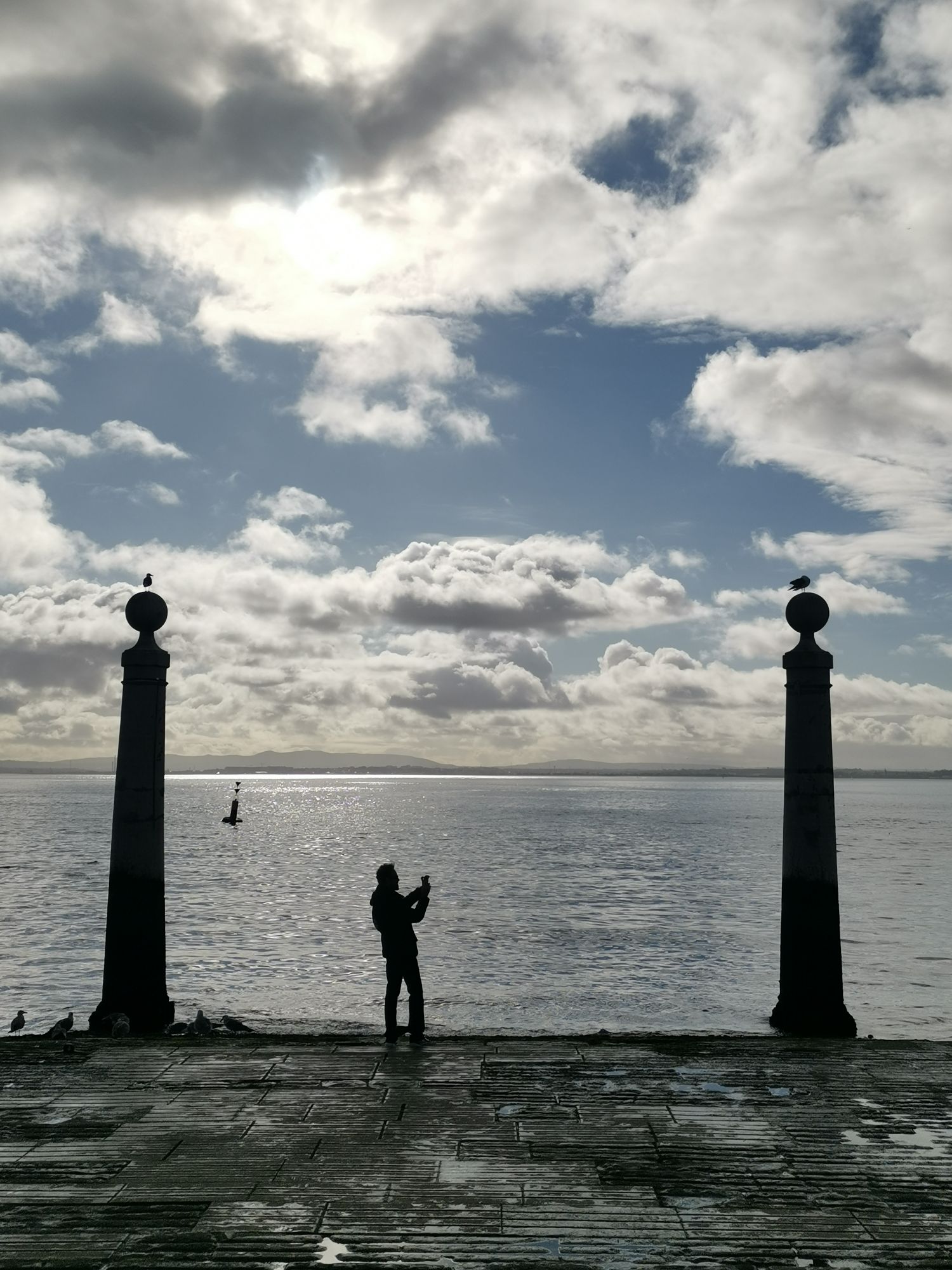
The Tagus has always been central to Lisbon’s identity. For centuries, it was Portugal’s gateway to the world. During the Age of Discoveries in the 15th and 16th centuries, ships departed from these waters carrying explorers like Vasco da Gama, connecting Europe to Africa, India, and beyond. Even on a rainy day, walking along the riverfront gives Lisbon a sense of scale and historical depth.


Baixa, Praça do Comércio, and the Weight of History
As we continued walking, we gradually entered Baixa, Lisbon’s downtown district, eventually reaching Praça do Comércio. This vast square opens directly onto the Tagus and was once the location of the Ribeira Palace, the royal palace destroyed in the 1755 Lisbon earthquake.
That earthquake — followed by fires and a tsunami — devastated much of the city. What stands today is the result of a major reconstruction led by the Marquis of Pombal, who introduced a grid-based urban plan and early earthquake-resistant building techniques known as the Pombaline cage. Walking through Baixa, even in the rain, you can sense how carefully Lisbon was rebuilt from disaster.

The guide was enthusiastic and lively, but I couldn’t help feeling that the explanations lacked deeper historical context. I found myself wanting more — stories about Lisbon’s past, its people, and how the city became what it is today.
Hippotrip: From City Streets Into the River

Nearby, we joined the Hippotrip amphibious bus tour. The idea itself is playful — a vehicle that functions as both a bus and a boat. Unfortunately, because of the rain, the vehicle remained closed most of the time.
When the bus finally drove into the Tagus and transformed into a boat, the experience changed. From the river, the city feels calmer and more distant. It’s easier to understand Lisbon as a maritime city, shaped by trade, navigation, and exploration. From the water, you can imagine landmarks like Belém Tower and the Monument to the Discoveries further downstream, both symbols of Portugal’s seafaring past.
The gentle rocking of the water, combined with the warmth inside, slowly lulled me into a light slumber — unplanned, but strangely comforting on such a cold, rainy afternoon.
Landeau Chocolate on Rua das Flores
After returning to land, the rain continued. We were close to Landeau Chocolate, located on Rua das Flores, so we decided to go.

Landeau is one of the most talked-about dessert spots in Lisbon, particularly famous for its chocolate cake. Despite the weather, it was busy. The cake was excellent — moist, creamy, and deeply chocolatey. The drink, however, was just okay.
Still, having a warm place to sit made a huge difference. We were lucky to get two seats; many others who arrived later couldn’t find a place to sit. On a rainy travel day, small comforts like this feel especially precious.

Supermarket Stop and Rest at the Hotel
When we finished our tea break, it was still raining. We stopped by a nearby supermarket to buy some groceries, then took a Bolt ride back to the hotel. After resting for a while and waiting for the rain to ease, we went out again in the evening.
Alfama: The Oldest Soul of Lisbon
While researching what to do at night, we came across a Fado performance, usually offered together with a drink. Curious to experience something cultural, we decided to go.
The venue was located in Alfama, Lisbon’s oldest district. It surprised me that I hadn’t discovered this area earlier. Alfama survived the 1755 earthquake largely intact, thanks to its position on solid rock. Its narrow alleys, steep stairways, and irregular layout still reflect its Moorish origins, dating back to when Lisbon was under Islamic rule.
Walking through Alfama feels like stepping into an older Lisbon — quieter, more intimate, and full of history.
Understanding Fado: Music of Saudade
The Fado performance featured two male singers and one female singer, accompanied by the Portuguese guitarra and classical guitar. Between songs, they explained the meaning, history, and characteristics of Fado.
The word Fado comes from Latin fatum, meaning fate. The music developed in 19th-century Lisbon among sailors, dockworkers, and working-class communities. At its heart is saudade — a deep feeling of longing, loss, and nostalgia that doesn’t translate easily into other languages.
The songs were melodic, emotional, and deeply moving. Even without understanding every lyric, the feeling came through clearly. I genuinely loved this experience — it felt authentic, intimate, and meaningful.
Walking to Chiado and a Bifana for Dinner
After the performance, it was time for dinner. We planned to take the tram back toward Chiado, one of Lisbon’s most elegant districts, known for its theatres, bookstores, and historic cafés. We wanted to try the local famous pork sandwich — the Bifana.
However, the tram never arrived in our direction. It kept coming on the opposite side, likely due to detours or delays. In the end, we decided to walk to Chiado instead, passing through older streets and by a softly lit church along the way.
The Bifana shop was extremely popular. The space was tight, cash only, and the man making the sandwiches looked visibly frustrated by the constant flow of customers. Despite the language barrier — they didn’t speak English and I don’t speak Portuguese — by deciding quickly what we wanted, we managed to order without trouble.
The Bifana was really delicious. Thin slices of pork marinated in garlic, white wine, and spices, served inside a crusty roll. Like most European bread, it becomes hard once it cools, so it’s best eaten immediately while hot. The pork was salty, but together with the bread, it worked perfectly.
Riding Tram Through the Night
After dinner and a short walk around Chiado, we decided to take the tram again — partly to rest our feet, and partly to see the city at night. Since our Navegante card covered public transport, it felt like a good opportunity.
We boarded Tram, Lisbon’s most iconic tram line. The tram passed through Mouraria, one of the city’s oldest neighbourhoods, and continued through Alfama and Baixa. I had heard that during peak season, people often queue for a long time and may not even get a seat. But perhaps because it was winter and low season, we were lucky enough to sit comfortably.
From the tram, we watched streetlights reflect off wet cobblestones and tiled façades. Lisbon looked romantic in the rain — quieter, softer, and more intimate.
In the end, it was a fruitful day, despite the weather.






Leave a Reply