
27 Dec 2025
Seville to Córdoba: An Early Start in Al-Andalus

Our day began early, riding the 7:51 AM train from Seville to Córdoba on December 27, 2025. This journey takes about 50 minutes to an hour and a half, with faster options not always being more expensive—it really depends on the demand.
A quick note on history: We were traveling through Andalusia, a region whose identity was profoundly shaped by centuries of Islamic rule (known as Al-Andalus). Córdoba was its crown jewel, a city whose period of greatest glory began in the 8th century after the Moorish conquest, when it rivaled the splendours of Constantinople, Damascus, and Baghdad.
We arrived in Córdoba at 8:35 AM. In late December, for some reason, it was way colder than our previous two days in Seville, even though it didn’t rain.
We had found out too late that the Mezquita-Cathedral offers free entry between 8:30 AM and 9:30 AM. With our paid ticket being for 10:30 AM (the earliest we could get when booking the day before was 10:00 AM), we decided to hang around and take our time walking the 20 to 30 minutes from the train station to the old town.


The city was real cold and most shops were closed, but as we got closer to the Mosque-Cathedral, we could visibly see more people clustering around. We walked into the orange orchard (the Patio de los Naranjos) to take some photos and saw people climbing up the bell tower. This tower was formerly the mosque’s minaret, from which the call to prayer was once made, a structure that was repurposed as a bell tower after the Christian Reconquest of the city. The entrance fee is 3 euros and it starts to admit guests at 9:30 AM.
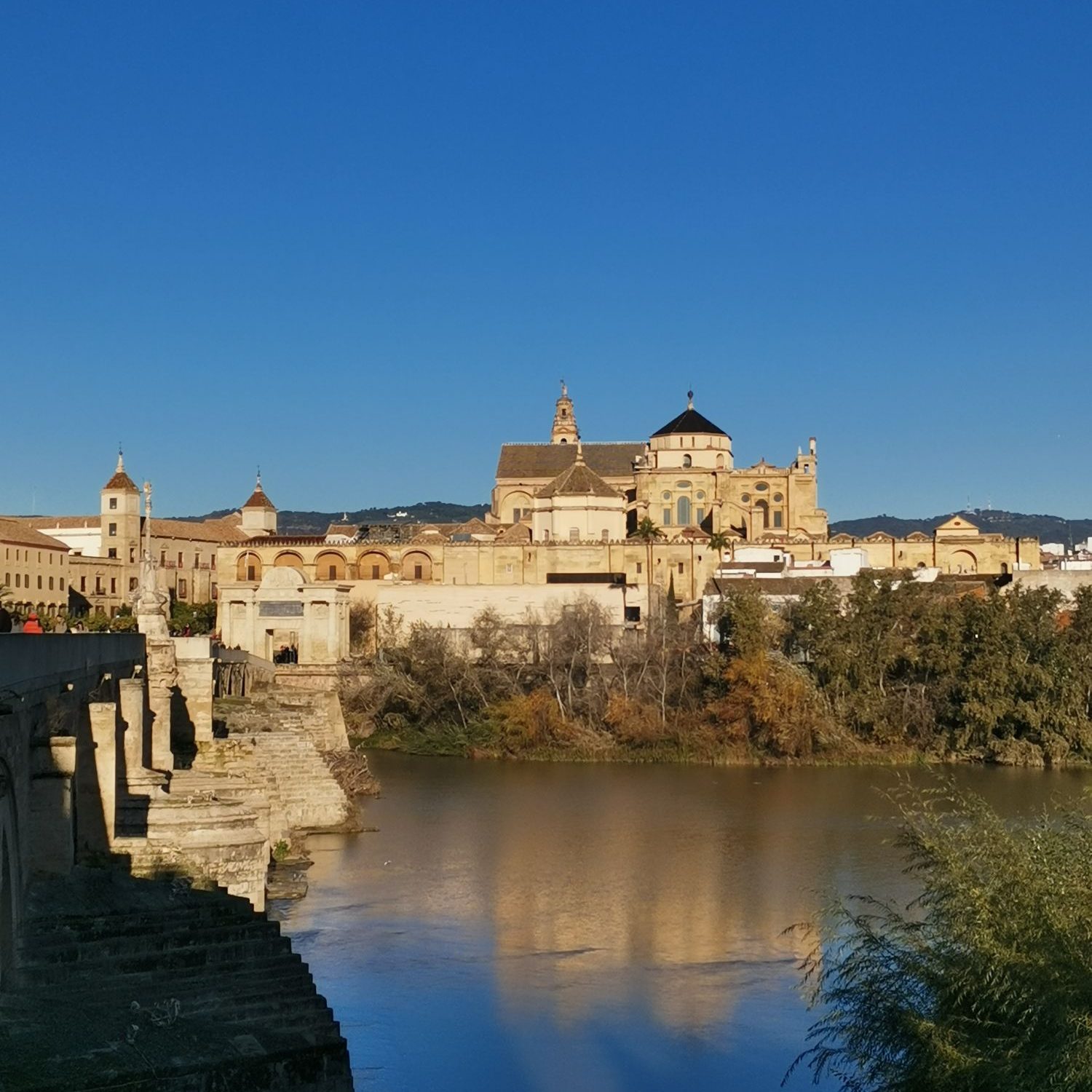
After that, we walked out and crossed the Puerta del Puente. The morning sun shone beautifully on the bridge, and there was a person playing the piano accordion, providing a serene vibe for the walk. Córdoba people must be very musical; we saw quite a few street artists playing different types of music throughout our short walk across the city. After crossing the bridge, we walked back because it was time to visit the mosque.


The Magnificent Mezquita-Cathedral

The red-and-white striped horseshoe arches are absolutely beautiful. This building is a unique fusion of Islamic and Christian architecture that was declared a UNESCO World Heritage Site in 1984.
The Mezquita was originally built as a mosque starting in 785 on the orders of the first Emir of Córdoba, Abd al-Rahman I, on the site of a former Visigothic church. It was expanded multiple times over the centuries of Islamic rule. In 1236, after the Christian Reconquest of Córdoba, it was converted into a Christian cathedral. Later, a full Renaissance cathedral was built right inside the massive prayer hall, resulting in the structure you see today.

I had to ask: is it just me, or does this building feel really tall? Cathedral naves are usually majestic, but the Mosque-Cathedral does feel taller than most. Its distinct construction, which uses a superposition of double arches, was actually an innovation that allowed for higher ceilings. The chapel/church inside was exquisite, and you can still see some old Muslim tiles. It is a big mosque/church, but otherwise, you could really finish the tour within an hour, unless you are keen to take a lot of photos and look at every little decoration.


The Siesta Wall: Where Impressions Ended

But otherwise, nothing else gave a lasting impression. This brings me to the biggest logistical challenge of the day: the Spanish siesta. Most churches are closed, starting from around 1:30 PM–2:00 PM and not reopening until 5:00 PM, 6:00 PM, or even 8:00 PM. With so many attractions closed, there was nothing much we could do except have our lunch.
Predictably, because lots of churches and other attractions were closed, the restaurants were busting with tourists. Note: while there are a few eateries that open during the morning, many restaurants open their doors at 1:00 PM to 2:00 PM. So, while you may have nowhere to visit as a tourist, you could always sit down and have lunch, although the waiting time could be long if you venture to a popular restaurant without a reservation. We found one and waited for 30 minutes before we decided to try our luck elsewhere.
Dining Like a Local (With a Tourist Bill)
The restaurant we ultimately found was very obviously for tourists, but after we sat down, it also filled up quickly, and some other customers had to wait for their turn. I haven’t experienced it elsewhere, but they also added a service charge to the bill, so be aware of that!
We tried their local dishes, and they were not bad.
Rabo de Toro: This traditional Andalusian oxtail stew is a regional specialty, particularly in Córdoba. It’s slow-cooked for hours in a rich sauce made with red wine, tomatoes, and aromatic herbs until the meat is incredibly tender and practically falling off the bone. It’s a hearty, soulful comfort food, perfect for a chilly day.
Salmorejo: We also had a portion of Salmorejo, a chilled, thick tomato puree that also originates from Córdoba. Unlike the thinner gazpacho, this is a velvety, substantial dish, typically topped with hard-boiled eggs and cured Spanish ham (jamón).


The Great Train Ticket Challenge
Here is the biggest challenge of our trip: Since the churches (included in the mosque ticket) were all closed and we are not really the lingering type, and the cold weather also affected us, we had very little to do. We were thinking of changing our late evening ticket to an earlier train.
But the website and app were slow to load, and while it showed we only needed to pay a €6 difference, the payment page always required us to pay the full price of a new ticket, so we didn’t dare to do it online. (Later we found out they might charge the full amount and refund the old ticket, but we are unsure of this process.) In any case, when we reached the train station, it was already too late to change to the 4-something train to go back early, and the next few trains were quite expensive, so we ended up just riding on our original ticket.
A note on the station: the ticket officer only spoke Spanish, but if you were using a translate app, he was quite patient in dealing with us, considering the language barrier. The other ticket officer did speak English, so it’s just luck on whether you could find an English-speaking officer if you are a non-Spanish speaker like me. I tried to pick up a few words at Duolingo and through reading and daily conversation, but it’s hardly enough for me to conduct a meaningful conversation, haha.
Final Thoughts and Essential Tips
At 6 something in the evening, it was time to go back to Seville. The Mezquita is beautiful, and the food is good, but maybe the weather was too cold for us to truly experience and appreciate the city. Perhaps with better planning and awareness of the local schedule (and warmer clothing), we would appreciate the city more.
One last essential tip: there are no Uber or Bolt services in Córdoba. You would need to hail a taxi if you want a quick lift. We rode the bus one time, which was delayed for approximately 8 minutes, if Google’s schedule is correct.

Leave a Reply