
5 January 2026
Leaving Rabat for Fes
We didn’t actually spend much time in Rabat.
Our stay there felt brief and slightly fragmented — a half-day walk through the city before hopping on to Casablanca for a day trip instead. Rabat was calm, orderly, almost restrained. In hindsight, that calm made what came next feel even more dramatic.
The journey from Rabat to Fes was long and largely uneventful — hours of watching the Moroccan landscape roll past the train window. Plains, muted winter skies, nothing particularly memorable happening. At that point, we had no idea how sharply the mood would change the moment we arrived.
🚆 Transport Note: Rabat to Fes
- Train: ONCF intercity trains
- Duration: ~3.5–4 hours
- Comfort: Modern, assigned seating, generally reliable
- Tip: Book earlier trains in winter to avoid arriving after dark
Arrival in Fes: Rain, Crowds, and Negotiation Fatigue


The moment we stepped out at Fes Railway Station, everything unravelled.
First, it was raining heavily — the kind of cold, persistent rain that soaks you faster than you expect.
Second, there were many people arriving at the same time, all competing for taxis and rides into the city.
It quickly turned chaotic.
Drivers were quoting prices that were far higher than normal, clearly taking advantage of the weather and demand. We hesitated. Others didn’t. And that hesitation cost us. While more assertive travellers secured rides quickly, we found ourselves stuck — watching car after car leave.
In the end, we turned to a ride-hailing app, but even that took time. Between poor weather, high demand, and slow matching, we were stranded for nearly 30 minutes, soaked, tired, and slightly defeated.
It was a small but telling introduction to Fes: a city that doesn’t ease you in.
🚕 Transport Tip: Getting from Fes Station
- Official petit taxis exist, but fares often inflate in rain or peak times
- Ride-hailing apps work, but expect delays
- Best advice: Ask your riad to pre-arrange pickup whenever possible
First Impressions: A Kind Riad, and a Necessary Warning

When we finally reached our riad, the mood shifted again.
Our host was warm, friendly, and reassuring — a small island of calm after the chaos. Almost immediately, he gave us advice that felt both practical and ominous:
“Don’t follow strangers who offer to guide you.”
In Fes el-Bali, this isn’t paranoia — it’s experience.
Introducing Fes: A City Without Cars (and With 9,000 Streets)
Fes is one of Morocco’s most historically significant cities, founded in 789 AD and later shaped into a centre of religion, scholarship, craftsmanship, and trade.


The Hidden Logic of Fes: Reading the Streets Without a Map
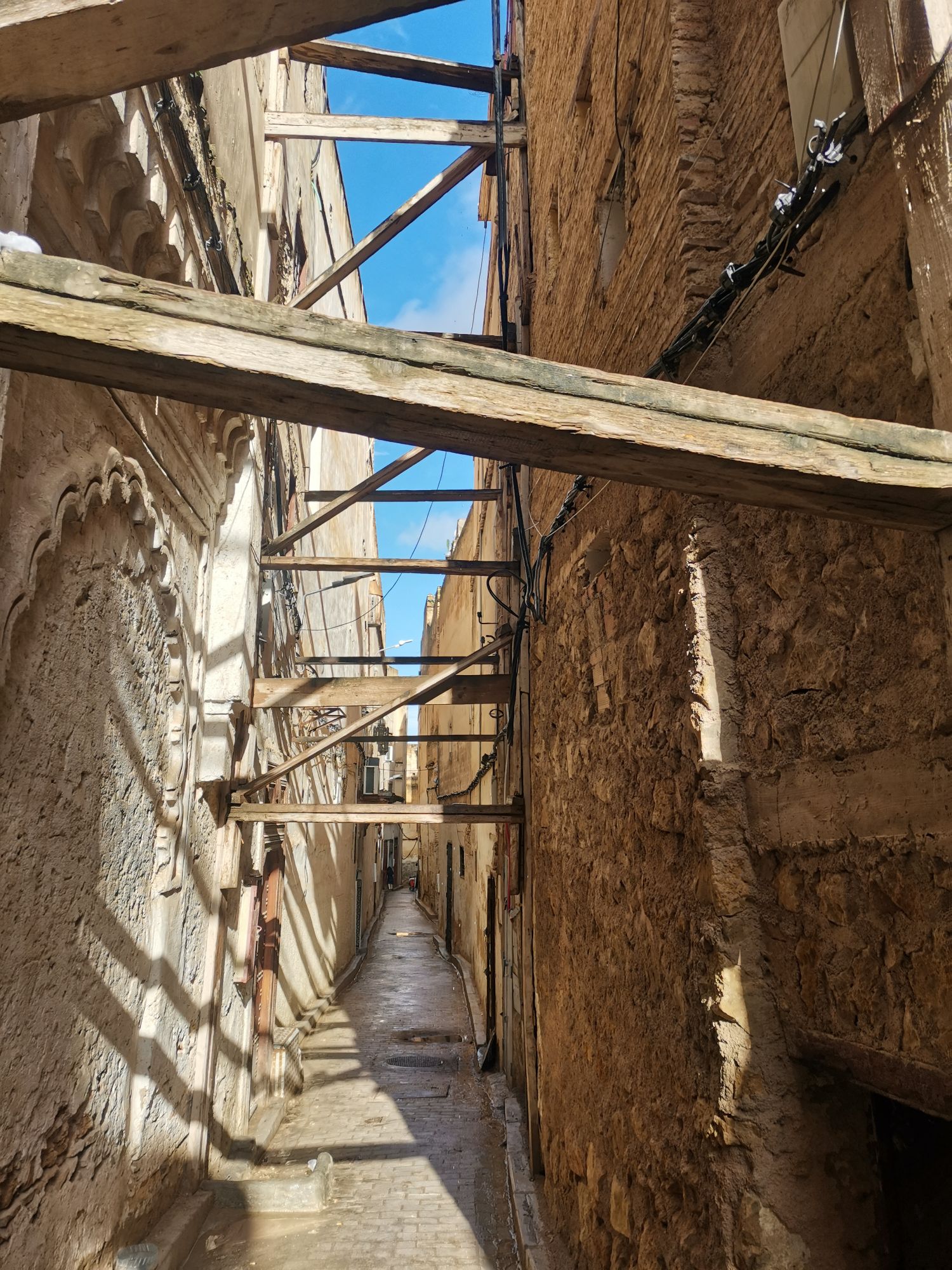
Its old city, Fes el-Bali, is often described as the largest car-free urban zone in the world, with an estimated 9,000 narrow streets and alleys. No cars. No grid. Just layers upon layers of history. Fes is not a city that reveals itself easily. Fes el-Bali is one of the largest medieval urban areas in the world — and also one of the most confusing for first-time visitors. What feels like chaos at first is, in fact, a carefully evolved system that predates street names, house numbers, and modern navigation.
UNESCO didn’t designate it a World Heritage Site for beauty alone — but for continuity. People still live, work, tan leather, hammer brass, and bake bread here using systems that haven’t fundamentally changed in centuries.
Here, the streets themselves are the language.
For visitors, though, it can feel like a maze designed to test your nerves.
In the old medina, width equals permission. If a lane is wide enough for two donkeys to pass, it is usually a public route. When the street suddenly narrows, slopes upward, or quiets down noticeably, you are likely entering a semi-private or residential area. A complete dead end is not a mistake — it is intentional, designed to protect privacy and slow outsiders.
Unlike modern cities, Fes does not rely on signs at eye level. Instead, orientation happens vertically. Minarets act as landmarks, guiding movement across neighbourhoods. We found ourselves circling back to the same minaret again and again — unconsciously using it as an anchor point — which is exactly how locals have navigated this city for centuries.


This system dates back to the city’s founding in the 9th century, when Fes grew organically around mosques, madrasas, fountains, and markets. Streets were shaped by daily life, not planning boards. Houses turned inward, communities protected themselves, and strangers were meant to feel slightly disoriented. In that context, the common advice from our riad host suddenly made sense: do not follow strangers offering directions. More often than not, “help” comes with expectations of payment, and following someone can pull you deeper into unfamiliar territory rather than back out.
A boy approached us, insisting we were going the wrong way — even though other people were clearly walking down the same street. His tone was confident, urgent. We hesitated, then decided not to follow.
Instead, we marched on with trepidation.
Eventually, we reached a minaret, one of the few vertical landmarks visible above the dense medina rooftops. It became our anchor point — a reference we circled back to again and again, slowly building our own mental map.
From there, we wandered deeper.
We passed workshops, tiny shops stacked floor to ceiling with goods, and streets so narrow they felt like corridors. We walked towards Al-Qarawiyyin University, the world’s oldest continuously operating university, founded in 859 AD.

We couldn’t enter — non-Muslims aren’t allowed inside — but we peeked in from the doorway. Even that brief glimpse carried weight. Knowing this place shaped centuries of Islamic scholarship gave the surrounding streets a different gravity.
And then, the rain worsened.
Retreat: Dinner, Shelter, and Reflection
As the rain intensified, the mood shifted again — from curiosity to caution. We decided it was time to eat and retreat back to the riad.

Fes was fascinating, but also overwhelming. The shops were intriguing, the streets alive with history, yet beneath it all was a constant awareness: this is the city people warn you about.
The notorious old medina of Fes.
And yet, even through the anxiety, there was something compelling. The sense that this wasn’t a place to be conquered in a day — but one to be slowly understood.
That first night wasn’t about falling in love with Fes.
It was about learning how to exist within it.
Practical Tips for Arriving in Fes
- Pre-arrange riad pickup, especially in rain or after dark
- Avoid following unsolicited guides — even if they seem helpful
- Use landmarks (minarets, main gates) to orient yourself
- Expect sensory overload: sound, smell, movement — it’s normal
- Winter evenings get cold and wet — plan shorter walks on arrival day
🧭 Historical Sidebar
Why Medieval Islamic Cities Avoided Street Signs
Medieval Islamic cities like Fes, Cairo, Damascus, and Aleppo were never designed for strangers to move through easily — and that was intentional.
Urban planning followed principles of privacy, community protection, and social hierarchy, rather than visibility or navigation. Streets were often unnamed, unmarked, and irregular because:
- Privacy came first: Homes turned inward toward courtyards, not outward toward the street. Clear signage would invite unnecessary foot traffic into residential zones.
- Neighborhood autonomy: Districts functioned like small villages. Locals knew their routes instinctively; outsiders were expected to ask permission or be accompanied.
- Security by confusion: Narrow alleys, dead ends, and sudden turns slowed invaders and discouraged theft.
- Orientation through landmarks: Instead of signs, people navigated by minarets, fountains, madrasas, and gates — vertical markers visible above the urban maze.
In cities like Fes el-Bali, this system has survived for over a thousand years. What feels disorienting to visitors today is actually a medieval logic still functioning exactly as intended.


Leave a Reply