

Growing up around Perak, family weekend outings almost always meant a visit to one of the limestone cave temples around the Kinta Valley. If you had asked my younger self to choose a favourite, Sam Poh Tong would have won without contest.
To a child, Sam Poh Tong was an effortless wonderland. You could feed the turtles around the pond, stare at the colourful scenes depicting hell and karmic judgment, and wander through cool cavern passages without having to tackle a long staircase.
Perak Tong felt like a very different experience.

Located at the foot of Gunung Tasek, north of Ipoh, this cave temple combines a natural limestone cavern with Buddhist sculpture, murals, Chinese calligraphy and a steep staircase that climbs through the mountain. Beyond the religious significance, it offers a fascinating glimpse into the history of the Chinese community that helped shape Ipoh during and after the Kinta Valley’s tin-mining boom.
Today, Perak Tong is one of Ipoh’s best-known cave temples, but its story is much more than the impressive golden Buddha inside the cavern.

A Cave Temple Born from an Immigrant Story
Perak Tong dates back to 1926, when Chong Sen Yee and his wife, Choong Chan Yoke, immigrants from Jiao-Ling in Guangdong, discovered the cave.
With approval from the Perak State Government, they began developing the natural cavern into a Buddhist temple. Chong Sen Yee concentrated on planning and construction, while his wife travelled extensively to raise funds, including donations from both local and overseas communities.
The temple was therefore not the result of a single building project completed in a few years.
It was developed over decades.
After Chong Sen Yee died in 1980 and Choong Chan Yoke died in 1983, their son continued the work. The development of Perak Tong eventually extended into the 1990s.


That long construction history is significant because it reflects a wider story about Ipoh itself.
During the late 19th and early 20th centuries, the Kinta Valley became one of the world’s major tin-producing regions. Chinese immigrants arrived in large numbers, establishing mining communities, businesses, associations, schools and religious institutions.
The cave temples around Ipoh were part of this social landscape.
They provided places not only for religious worship, but also for communities to maintain cultural traditions far from their ancestral homes in southern China.
Why Ipoh Has So Many Limestone Cave Temples
The geography of the Kinta Valley explains much of the story.
Ipoh is surrounded by dramatic limestone karst hills, some of which rise abruptly from the relatively flat valley floor. These formations contain natural caves and chambers that have been shaped by geological processes over immense periods of time.
For Buddhist and Chinese communities arriving in the region, these natural caves provided an unusual opportunity.
Rather than building an entirely separate structure, a temple could be incorporated directly into the mountain.
At Perak Tong, the distinction between natural landscape and religious architecture is therefore blurred.
The limestone becomes the walls.
The cavern becomes the temple hall.
Natural openings provide light.
And the mountain itself becomes part of the religious experience.
This is one reason the cave temples around Ipoh are so distinctive compared with conventional temples built on flat ground.
Entering Perak Tong: A Temple Inside the Mountain
The first impression of Perak Tong is the dramatic change from Ipoh’s tropical heat outside to the cooler atmosphere of the cavern.
Inside the main chamber, the natural limestone walls rise around a large Buddhist sanctuary.

The centrepiece is an enormous 40-foot golden seated Buddha, one of the temple’s most recognisable features. The statue is surrounded by other religious figures and guardian deities.
But the statue is only one part of what makes the cavern interesting.

Look beyond the main altar and the walls themselves begin to tell another story.
Paintings, religious imagery and Chinese calligraphy cover sections of the limestone surface. Rather than being displayed as separate artworks in frames, the murals interact with the irregular contours of the cave.
Some areas are smooth.
Others are deeply textured.
Cracks, hollows and natural formations remain visible around the artwork.
The result is a very different kind of gallery—one in which the canvas is the mountain itself.
Murals, Buddhist Stories and Chinese Artistic Traditions
The murals inside Perak Tong combine Buddhist religious imagery with traditional Chinese artistic conventions.
Among the scenes are figures associated with Buddhist teachings, Chinese mythology and religious stories. Some are brightly coloured, while others have become more muted with age.

The second photograph above gives a good sense of this environment.
A richly illustrated religious figure occupies the centre of the composition, while Chinese calligraphy appears alongside it. The painting follows the shape of the limestone rather than being confined to a rectangular canvas.
This is important when looking at cave temples.

The artwork is not simply decoration added to an existing building.
It is part of an environment where religion, art and geology overlap.
The cave also remains an active religious space. Visitors may encounter worshippers, incense and offerings alongside tourists taking photographs.
That makes Perak Tong different from a conventional museum.
The murals are not simply historical objects preserved behind glass. They remain part of a functioning temple.
Ipoh, Sun Yat-sen and the Chinese Revolutionary Era
Perak Tong also sits within a much broader history of Chinese cultural and political activity in Ipoh.
During the late Qing period and the early years of the Republic of China, overseas Chinese communities in Malaya became important sources of financial and organisational support for political movements in China.
Dr Sun Yat-sen, whose revolutionary movement eventually contributed to the overthrow of the Qing dynasty in 1911, had significant connections with Perak and the Chinese communities of Malaya.
Ipoh and other parts of Perak participated in fundraising and support networks associated with the revolutionary movement, including support connected with the 1911 Huanghuagang uprising.
There is, however, an important distinction.
Sun Yat-sen did not visit Perak Tong itself.
Perak Tong began developing in 1926, while Sun Yat-sen died in 1925.
The connection is therefore not that Sun visited this particular cave temple, but that Perak Tong developed within an Ipoh Chinese community that already had a long history of links with China, politics, education, literature and cultural exchange.
That background helps explain why Chinese cultural traditions became so deeply embedded in places such as Perak Tong.
Calligraphy on Limestone
The temple’s calligraphy adds another layer to its cultural significance.
Chinese calligraphy has traditionally been much more than decorative handwriting. It is an art form requiring years of discipline, control and familiarity with classical literature.
At Perak Tong, inscriptions become part of the physical landscape.
Instead of hanging a scroll on a wall, words appear directly against stone.
This creates an unusual meeting between human-made cultural expression and natural geological time.
The cave may have existed for millions of years, while the inscription represents a particular historical moment, written by a particular person for a particular community.
Among the prominent cultural figures associated with Perak Tong are names such as Yu Youren (于右任), Zhang Daqian (张大千) and Hu Shih (胡适). Their association with the temple forms part of its broader literary and cultural history, although individual inscriptions should be identified from the temple’s own records rather than assuming that every piece of calligraphy belongs to one of these figures.
This combination of cave, painting and calligraphy is what gives Perak Tong much of its character.
When Art Meets Natural Cave Conservation
There is an interesting question here that is difficult to avoid.
When does writing or painting on a cave wall become cultural heritage, and when does it become vandalism?

Modern cave conservation generally treats limestone formations as fragile geological features. Stalactites and related formations develop extremely slowly, and touching, scratching or otherwise damaging natural cave surfaces can permanently affect them.
From that perspective, modern graffiti on a cave wall is clearly destructive.
But historic inscriptions can be viewed very differently.
They may provide evidence of the people who used the cave, the language they spoke, the religious ideas they valued and the cultural networks they belonged to.
The distinction often comes down to context, intention and historical value.
A random name carved into a protected cave today is unlikely to have much cultural significance.
A centuries-old inscription by a known scholar may become an important historical record.
Time changes how we interpret human marks.
That is one of the more interesting tensions within places like Perak Tong: the cave is simultaneously a natural geological environment, a religious space and a record of human cultural activity.
The Staircase into the Limestone Hill
The main cavern is not the end of the visit.
Behind the temple, a staircase climbs through the limestone hill.
Sources commonly describe the route as involving around 450 steps, although some descriptions distinguish between different sections of the internal staircase and the route to the summit.
This is where the character of the temple changes.
The first part of the climb is enclosed by limestone.
The walls rise on both sides, and the natural rock formations create a dramatic tunnel-like passage.
Then the cave begins to open.
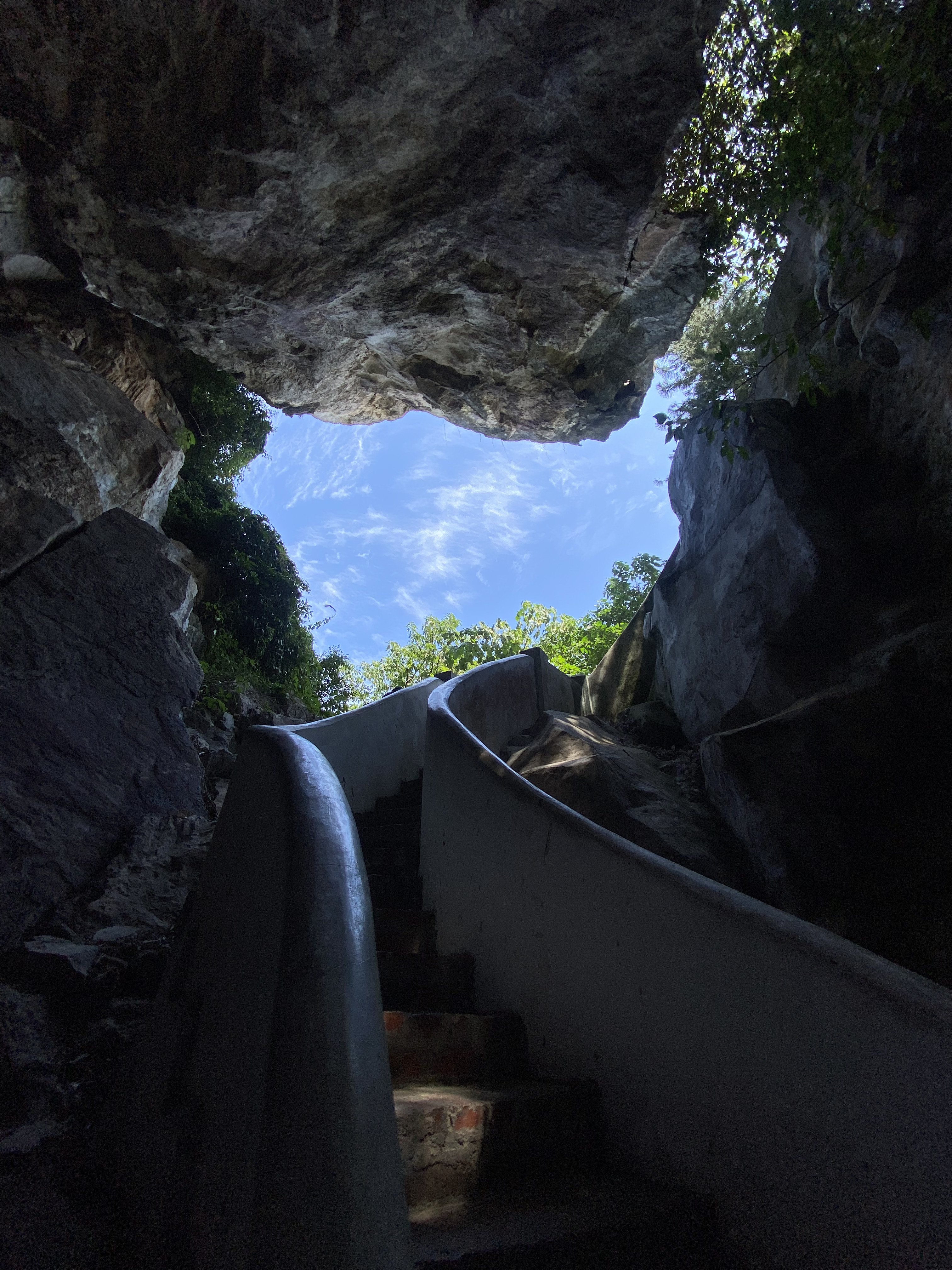
The first photograph captures this transition particularly well.
The staircase rises through the dark limestone, while a bright patch of blue sky appears above. Tropical vegetation frames the opening, creating a striking contrast between the cool darkness of the cave and the intense sunlight outside.
It is one of the most memorable visual features of the climb.
From Cave Darkness to an Ipoh View
Continue upwards and the route eventually reaches open areas, pavilions and viewpoints on the limestone hill.
From higher up, the surrounding landscape becomes much easier to understand.
The urban area of Ipoh stretches across the valley, while limestone hills rise dramatically from the surrounding landscape.
The view provides a useful reminder that the cave temple is not an isolated attraction.
The temple exists because of the landscape.
The landscape influenced where people built.
And the people who settled here subsequently gave the landscape additional cultural meaning.
This relationship between karst geology and human settlement is one of the defining characteristics of Ipoh.
The 2009 Rockfall
There is also a more recent and sobering chapter in Perak Tong’s history.
On 11 January 2009, a major rockfall occurred at the temple, destroying part of the staircase leading towards the summit.
Eighteen people were trapped, with several suffering injuries. Temple security guard Yip Lum Choon, aged 55, died in the incident. His body was recovered several days later.
The incident is an important reminder that limestone caves are natural geological environments rather than conventional buildings.
Rockfalls are uncommon, but the possibility should never be completely dismissed in a steep karst landscape, particularly during periods of heavy rainfall.
For visitors, the practical lesson is straightforward:
Wear shoes with good grip, stay on designated paths and take extra care when the weather is wet.
There is no need to avoid Perak Tong because of the incident, but it is worth remembering that the spectacular scenery is the result of a natural environment that continues to change.
How Long Do You Need at Perak Tong?
If you only want to see the main cavern, Buddha statue and murals, you can visit relatively quickly.
However, allowing around 1 to 2 hours gives you enough time to explore the temple without rushing and, if conditions allow, attempt the climb towards the upper viewpoints.
The main temple area is considerably easier than the staircase.
Visitors who are elderly, travelling with young children or simply prefer a slower visit do not need to climb to the summit to appreciate Perak Tong.
The murals, statues and cave architecture are concentrated in the main temple area.
The upper climb is an additional experience rather than a requirement.
Practical Guide to Visiting Perak Tong Cave Temple
Location:
Jalan Kuala Kangsar, Kawasan Perindustrian Tasek, 31400 Ipoh, Perak, Malaysia.
Google Maps:
Perak Tong Cave Temple on Google Maps
Opening hours:
Current travel information generally lists the temple as open daily from around 8:00 AM to 5:00 PM.
Because opening times can change, it is sensible to check before travelling, especially if you are making a special trip.
Entrance fee:
Free admission. Donations are welcome.
Getting there
By car:
Driving is the easiest option. Perak Tong is located along Jalan Kuala Kangsar on the northern side of Ipoh, close to the Ipoh Utara area.
By Grab or taxi:
Ride-hailing is convenient from Ipoh Old Town, Ipoh Railway Station or other parts of the city.
By public bus:
Public bus services towards the Kuala Kangsar area serve the northern part of Ipoh, although routes and schedules can change. Check the latest local timetable before relying on the bus.
Visiting tips
- Wear shoes with good grip if you intend to climb the upper staircase.
- Bring drinking water, particularly on hot days.
- Allow extra time if you want to photograph the murals and calligraphy.
- The main cave can be explored without completing the summit climb.
- Avoid climbing during heavy rain.
- Be respectful of worshippers and avoid blocking areas used for prayer.
- The cave can be darker than expected, although the main visitor areas are illuminated.
- Early morning is generally more comfortable for climbing because of the heat.
Perak Tong: Where Ipoh’s Natural and Cultural Histories Meet
Perak Tong is easy to describe as a cave temple, but that label only tells part of the story.
It is a Buddhist temple built into an ancient limestone landscape.
It is also a record of Chinese immigration and community-building in the Kinta Valley.
Its murals and calligraphy preserve layers of religious and artistic traditions, while the staircase provides a completely different perspective of the surrounding landscape.
And beneath all of this is the limestone itself—the geological foundation that made the entire site possible.
For visitors interested in Ipoh’s history, Perak Tong offers something beyond a quick temple stop. The cavern provides a glimpse into the religious life of the Chinese community, the artwork reveals traditional cultural influences, and the climb connects the temple directly with the dramatic karst landscape surrounding Ipoh.
For anyone exploring the city’s famous limestone heritage, Perak Tong deserves a place on the itinerary—not simply because of its enormous golden Buddha, but because of the many layers of history, art, religion and geology contained within the mountain.




Leave a Reply