

18 September 2026
We woke up fairly early this morning, but there was no breakfast at the hotel, so after checking out we decided to make one last stop at Lake Hill Farm, which was just beside the hotel.
The farm is known for its handmade gelato and dairy products. We had the pudding and a rum-and-raisin ice cream. The ice cream was soft and fluffy, and very easy to eat even though it was still morning.
What caught our attention more, though, were the flowers in front of the café and gelato shop.
There were bees moving from sunflower to sunflower and around the other flowers, collecting nectar. After hearing so much over the years about declining bee populations and how important pollinators are to agriculture, it was surprisingly nice just to stand there and watch them doing exactly what bees are supposed to do.
Although, to be honest, I still dodged whenever one flew too close. Knowing that bees are important does not necessarily mean I want one landing on me.
Lake Hill Farm sits on the hills above Lake Toya, with views towards Mt Yotei and the Niseko mountains. The setting also gives some perspective on why Hokkaido’s dairy farming and agricultural products are such a big part of its food culture. The farm combines that landscape with its own milk-based products, so the gelato is very much tied to where we were rather than simply being another dessert stop.


One more look at Lake Toya
After that, we drove back towards Toya Onsen Town because we wanted another look at the lake before heading towards Sapporo.
Technically, we had never really left Lake Toya. Our hotel had also been beside the lake, but Lake Toya is large enough that being “beside Lake Toya” and actually being in the lakeside town are two slightly different experiences.


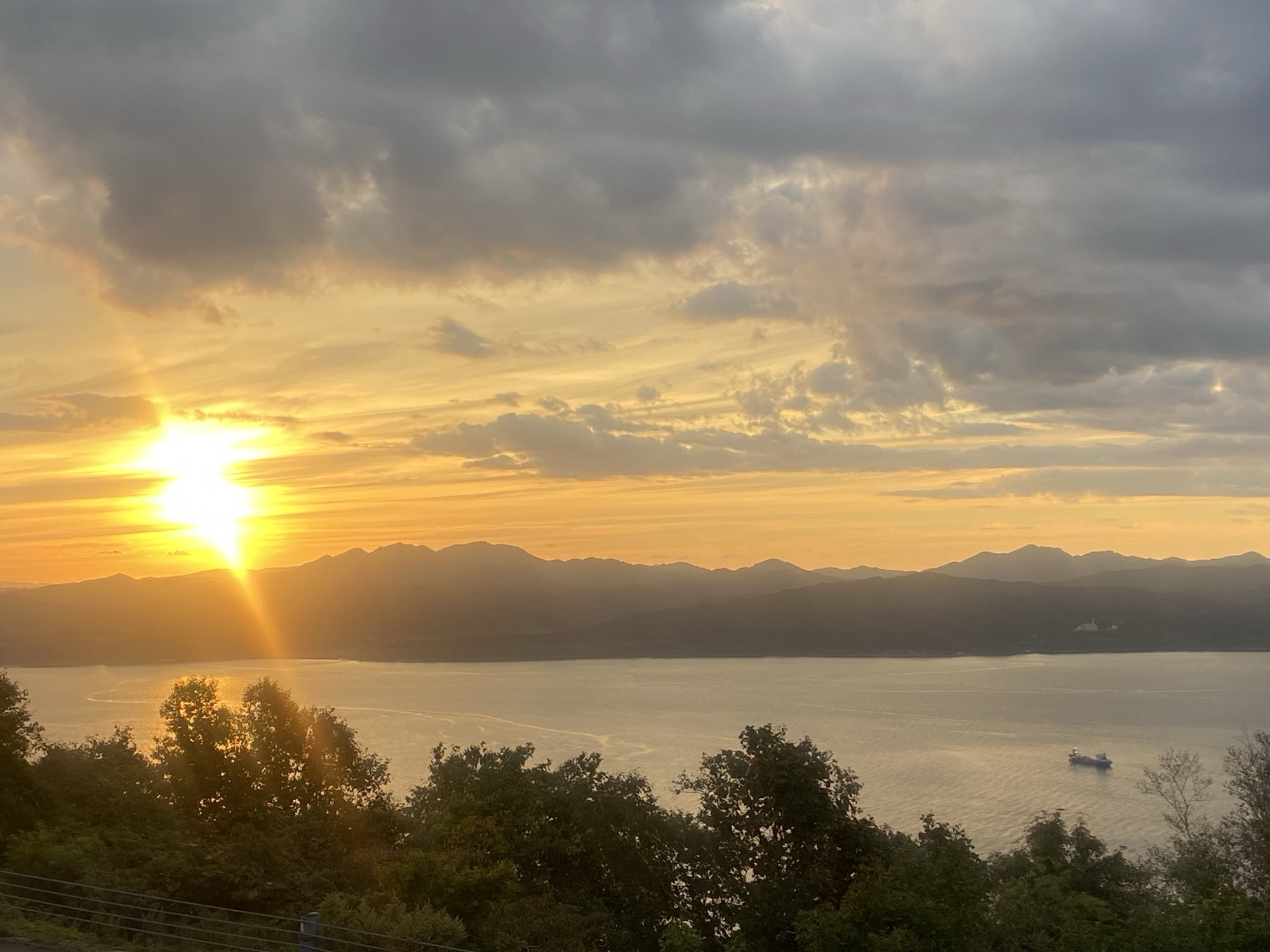
Lake Toya itself is a volcanic caldera lake, formed by a huge eruption thousands of years ago. Today, the lake is one of the defining landscapes of southwestern Hokkaido, with Mt Usu and Showa-shinzan nearby. The scenery is one of those things that keeps changing depending on where you stand, which was partly why we wanted one more look before leaving.
Back in town, I noticed the Wakasaimo shop we had seen earlier and we stopped for another look.
We finally found the shiso juice we had been looking for for quite some time, so that was a pleasant surprise. Red shiso is one of the flavours that keeps appearing around Hokkaido and Lake Toya, and the local version is particularly associated with the area.
We also tried their famous いもてん (Imoten).
I had initially thought it was simply another Hokkaido version of a fried potato, but it is actually more interesting than that. Wakasaimo is a Hokkaido confection created to resemble a roasted sweet potato, and the Toya shop is known for serving it freshly deep-fried as imoten. So although it looks like something potato-based, it is actually a sweet confection turned into a hot, crispy snack.
It was nice, although definitely different from what we normally think of as a potato snack.
That reminded me again of how much Hokkaido seems to love potatoes. Everywhere we go, potatoes appear in different forms — fried, baked, mashed, made into croquettes, snacks and sweets. The climate and large-scale agriculture here have made potatoes one of Hokkaido’s important crops, and local food culture has found an impressive number of ways to use them.
We had originally planned to walk further along the lake in front of the shop, but part of the road was being paved, so that particular stretch was not really suitable for walking.
Instead, we went back to the onigiri shop we had noticed yesterday.
It was simple, but nice, and then we were ready to leave Lake Toya and start the drive towards Sapporo.
Taking the slower road over Nakayama Pass
We were not planning to use the toll road, so instead of taking the faster expressway route, we followed the road towards Nakayama Pass (Nakayama Toge).
Nakayama Pass is an important mountain route between southern and central Hokkaido, particularly for traffic travelling between Sapporo, Lake Toya and the Niseko area. At the summit is Boyo Nakayama Roadside Station, which is famous for one particular snack: Toge no Ageimo, the deep-fried potato of Nakayama Pass.
So, naturally, we had to stop.
The ageimo comes as potatoes covered in a thick, crisp batter and deep-fried. The outside has an almost doughnut-like appearance, which is probably why it looks so different from ordinary fried potatoes.
It was definitely something different.
It was also extremely filling.
We had only been looking for a snack, but after eating it we realised that this was not really a light little roadside nibble. The combination of potato and thick fried batter gets heavy quite quickly.


There is a reason it has become such a famous local food, though. Ageimo has been associated with Nakayama Pass for decades and is now recognised by Japan’s Agency for Cultural Affairs as a 100-Year Food, reflecting its long connection with local food culture. The roadside station says it sells around 300,000 pieces a year.
For anyone driving this route, the roadside station is an easy stop, with toilets, food, souvenirs and a rest area. In clear weather there is also a view towards Mt Yotei.
After the ageimo, we continued towards Jozankei.
A short stop in Jozankei Onsen


From Nakayama Pass, Jozankei was only around 25 minutes away by car, and we reached it much faster than expected.
Jozankei really is an onsen town, rather than simply a place with one or two hot-spring hotels. The town stretches along the Toyohira River, surrounded by forested mountains, and it is one of the major hot-spring areas within Sapporo.
Its history goes back to 1866, when the monk Mizumi Jozan was guided to the hot springs by Ainu people. He eventually established a healing settlement here, and the area became known as Jozankei. The town later developed into a major resort destination, particularly as Sapporo grew.
We only made a short visit, but we managed to wash our hands at one of the town’s hand baths, soak our feet in a footbath and walk across Futami Tsuribashi, the red suspension bridge over the Toyohira River.
The bridge is one of Jozankei’s recognisable viewpoints. Below it are the rocks known as Futami-iwa and the pool associated with Jozankei’s local kappa legends. The kappa has become something of a mascot for the town, appearing in statues, signs and souvenirs around Jozankei.
We also walked to Iwato Kannondo.
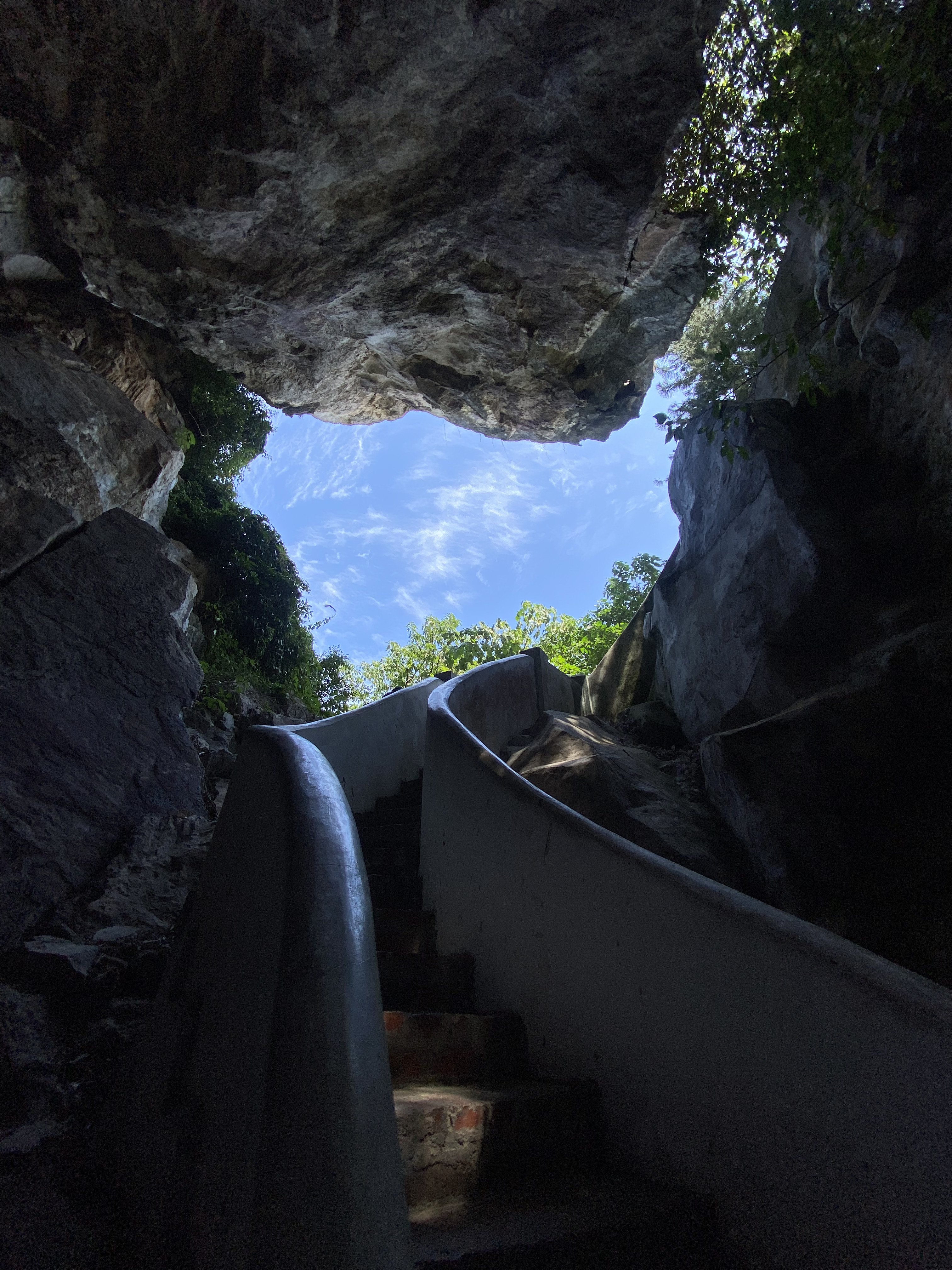
The temple is particularly unusual because the Kannon statues are inside a cave. The cave extends for around 120 metres and contains 33 Kannon statues, representing the 33 manifestations of Kannon, the Buddhist bodhisattva associated with compassion.
The hall and cave were built in 1936, and the site was also established to honour people who died during construction of the road connecting Otaru and Jozankei and to pray for traffic safety. Admission to the cave is currently ¥300 for adults, with the surrounding site free to enter.
Jozankei was interesting because there was more history packed into this little valley than we initially expected.
But there was also something else that caught my attention.
The abandoned hotel in the middle of Jozankei


Right in the middle of the town stood a huge abandoned hotel.
It was hard to miss.
Seeing such a large building sitting unused in the middle of an otherwise active hot-spring town felt strangely sad. A hotel of that size would once have been full of people — guests arriving with luggage, families going to the baths, meals being served, children running around, buses arriving and leaving.
And then, suddenly, nothing.
The building is the former Jozankei Hotel, one of the old hotels in the town. It first opened in 1918, making it one of Jozankei’s long-established accommodation businesses. Over the years it expanded into a large complex with multiple buildings and extensive bathing and leisure facilities.
The hotel stopped operating on 6 May 2021. It had already been struggling with an ageing building and declining demand, and the COVID-19 period added further pressure. The hotel was subsequently caught up in a long process involving its ownership and the future of the property; by 2025, the land and buildings had changed hands through a public auction process.
There is actually a bigger story here than one abandoned hotel.
Research into Jozankei has found that the town had a number of closed corporate recreation facilities and accommodation buildings, particularly from the 1990s onwards. Changes in corporate welfare, declining use and the high cost of maintaining large buildings contributed to the decline of some of these properties. Some were later reused, while others were demolished or left unused.
That made the abandoned building we saw feel less like an isolated oddity and more like part of the history of Japanese hot-spring towns.
It was still a little sad to see, though.
Especially because it was right in the centre of town.
We did not stay long in Jozankei. We bought an apple tart that looked really good, picked up some pottery from one of the shops, and then continued towards Sapporo.
I’m glad we made the stop because it was directly on our driving route. If we had come all the way from Sapporo specifically just to visit Jozankei, I am not sure we would have felt the same way. It is charming and has plenty of atmosphere, but the central sightseeing area is fairly compact. For us, it worked particularly well as a stop between Lake Toya and Sapporo.
Back to Sapporo and Jingisukan for dinner
Eventually we reached Sapporo, returned the rental car and checked into the hotel.
After travelling by car for several days, it was nice to hand the keys back and return to walking around the city.
For dinner, we had booked Kiwami Shio Jukusei Jingisukan Yuhi (極み塩熟成ジンギスカン ゆうひ) in Susukino.


We arrived at around 5:10pm, which was just after the restaurant’s listed 5:00pm opening time. Surprisingly, there were already several tables eating.
That made us even more grateful that we had made a reservation.
The restaurant specialises in Jingisukan, Hokkaido’s famous grilled lamb dish. Jingisukan is generally cooked at the table on a distinctive domed or raised metal grill, with lamb and vegetables cooked together. Hokkaido has a particularly strong association with lamb barbecue, and the dish has become one of the foods visitors often seek out in Sapporo.
Yuhi’s speciality is **salt-aged lamb**, where the meat is aged with salt to concentrate its flavour. The restaurant also serves other cuts of lamb and different Jingisukan preparations.
We had the lamb, and it was nice.
The downside was predictable: after grilling lamb at the table, our clothes were absolutely full of smoky barbecue smell.
Luckily, our hotel was close enough that we could simply walk back, shower and change.
The original plan was to go out again after the shower.
But by the time we were clean and back in the room, we were just too tired.
So we stayed in.
And that was our day — one last look at Lake Toya, a farm breakfast without actually having breakfast, shiso juice, a very filling ageimo at Nakayama Pass, a short walk through Jozankei, an unexpected encounter with the remains of an old hotel, and finally lamb in Susukino before calling it a night.




Leave a Reply