
16 September 2026
We woke up to the hotel’s free toast breakfast. The thick-cut toast was nice, but honestly, the boiled egg was the highlight for me — cooked almost perfectly, with the yolk still retaining just a little moisture rather than being completely dry. A small thing, but sometimes it is these little breakfast details that make a hotel morning memorable.
After breakfast, we walked towards Hakodate Morning Market (Hakodate Asaichi), one of the city’s best-known places to experience its seafood culture.


The market was already lively, with stalls selling fresh seafood, melons and all sorts of local produce. One of the attractions here is the live squid fishing experience, where visitors can catch a squid from a tank and have it prepared immediately.
Hakodate’s relationship with seafood is hardly surprising. The city sits at the southern tip of Hokkaido, where the waters around the Tsugaru Strait and surrounding seas have long supported an important fishing industry. Squid, in particular, became closely associated with Hakodate and remains one of the city’s signature foods.
The other famous breakfast here is kaisendon, a bowl of rice topped with assorted fresh seafood. We had already eaten at the hotel, though, so we resisted the temptation and simply walked around the market.
That turned out to be quite useful because we had a full day ahead.
Hakodate at 9am: a little too early
From the market, we continued towards the Kanemori Red Brick Warehouse area. We were there at around 9am, which, as it turned out, was rather early. Many of the shops and attractions were not even open yet.
The red-brick warehouses are not simply shopping buildings with an old-fashioned appearance. They are remnants of Hakodate’s history as one of Japan’s earliest international trading ports.


Hakodate was one of the ports opened to foreign trade in the final years of the Tokugawa shogunate following the arrival of the Western powers. The city subsequently became an important gateway for international trade, and its waterfront developed with warehouses and commercial buildings associated with this new trading economy.
Today, the warehouses have been converted into shops, restaurants and cafes, so the atmosphere is considerably more leisurely than it would have been during Hakodate’s commercial heyday.
Since we were on our usual quest to collect manhole cards, however, we had another destination in mind: the Hakodate Community Design Center, where we picked up another card for the collection.


From there, we headed towards the famous slopes of Hakodate’s Motomachi district.
Hakodate is an unusually hilly city for a place that most visitors initially associate with its waterfront. The slopes rise from the harbour towards Mount Hakodate, and several of them have become landmarks in their own right.

We managed to take a photo around Hachimanzaka, although I suspect the view probably looked better in reality than it did in my photograph. Photography skills aside, the weather could hardly have been better.

It was a perfect day.
The sun was shining brightly, but the air was cool and breezy, making the uphill and downhill walking surprisingly pleasant.
Motomachi’s churches and temples
The Motomachi area is one of the most historically interesting parts of Hakodate because of what happened after the port opened to foreign residents and trade.
Foreign communities established themselves around the port, and Western religious institutions followed. This is why visitors can find several Christian churches clustered around the slopes, alongside Japanese Buddhist temples and other historic buildings.

We visited some of the churches, although, to be honest, they did not attract me particularly strongly. After seeing so many beautiful churches during our travels in Europe, I have probably become rather spoiled when it comes to church architecture.
The temple beside them, however, caught our attention much more.

It was closed and undergoing maintenance when we visited, but somehow that made it more intriguing. The contrast between the Buddhist temple, the Western churches and the old streets around them really showed how unusual this small part of Hakodate is.
Walking down the slopes afterwards, I noticed something else that had nothing to do with the official tourist attractions.
There was an abandoned house.
The garden had become completely overgrown, with vegetation growing everywhere, but through all of it we could still see mature trees, including pine trees. The old entrance and door were particularly charming.
I couldn’t help wondering why it had been abandoned.
Perhaps the house had simply become too expensive or difficult to maintain. Perhaps the owners had moved away. Perhaps there was another story behind it that we would never know.
I am just not used to seeing abandoned houses like this in the middle of a Japanese city. In rural Japan, abandoned houses are something we encounter fairly often, but seeing one tucked among the historic streets of a city was a curious observation.
Kanemori Red Brick Warehouse
Eventually, we made our way back down to the Kanemori Red Brick Warehouse.


It was fun walking around the shops, especially with the old warehouse buildings and waterfront setting.
But honestly, if you are not particularly interested in shopping, there is not a huge amount to do here. The attraction is more about wandering through the historic waterfront setting, looking at the architecture and browsing the shops rather than ticking off a long list of attractions.
We did, however, find time for coffee and cake.
And that was great.
Sometimes sitting down with a coffee after walking around a city is all we need.
Early lunch at Grand E Aqua
For lunch, we headed to Grand E Aqua, which opens at 11:30am. We arrived early enough to be the first group inside.
We ordered a set lunch with pizza and another set with pasta.
The food was really good, and I particularly enjoyed the white cream sauce. The charcoal pizza was also quite fun.


What made the meal more memorable was watching the chef prepare the pizza from the dough in front of us while we were sitting at the counter.
Our Japanese was not good enough for much conversation, but the chef was friendly and communicated through gestures as he prepared the pizzas. It was one of those simple interactions that does not require much language.
After lunch, we took the tram back towards the hotel and had a long rest.

That turned out to be a good decision because we had one more major Hakodate experience planned for the evening.
Hakodate Ropeway and the famous mountain view
Fortunately, our hotel was close to a post office, so we took the opportunity to send out some postcards before heading out again.
Since we wanted to see the sunset from Mount Hakodate, we deliberately left ourselves plenty of time to rest during the afternoon.


Around 4pm, we walked towards the Hakodate Ropeway station and took the ropeway up the mountain.
We were a little salty and tired by the time we reached the top, so we sat down and waited.
It was worth it.
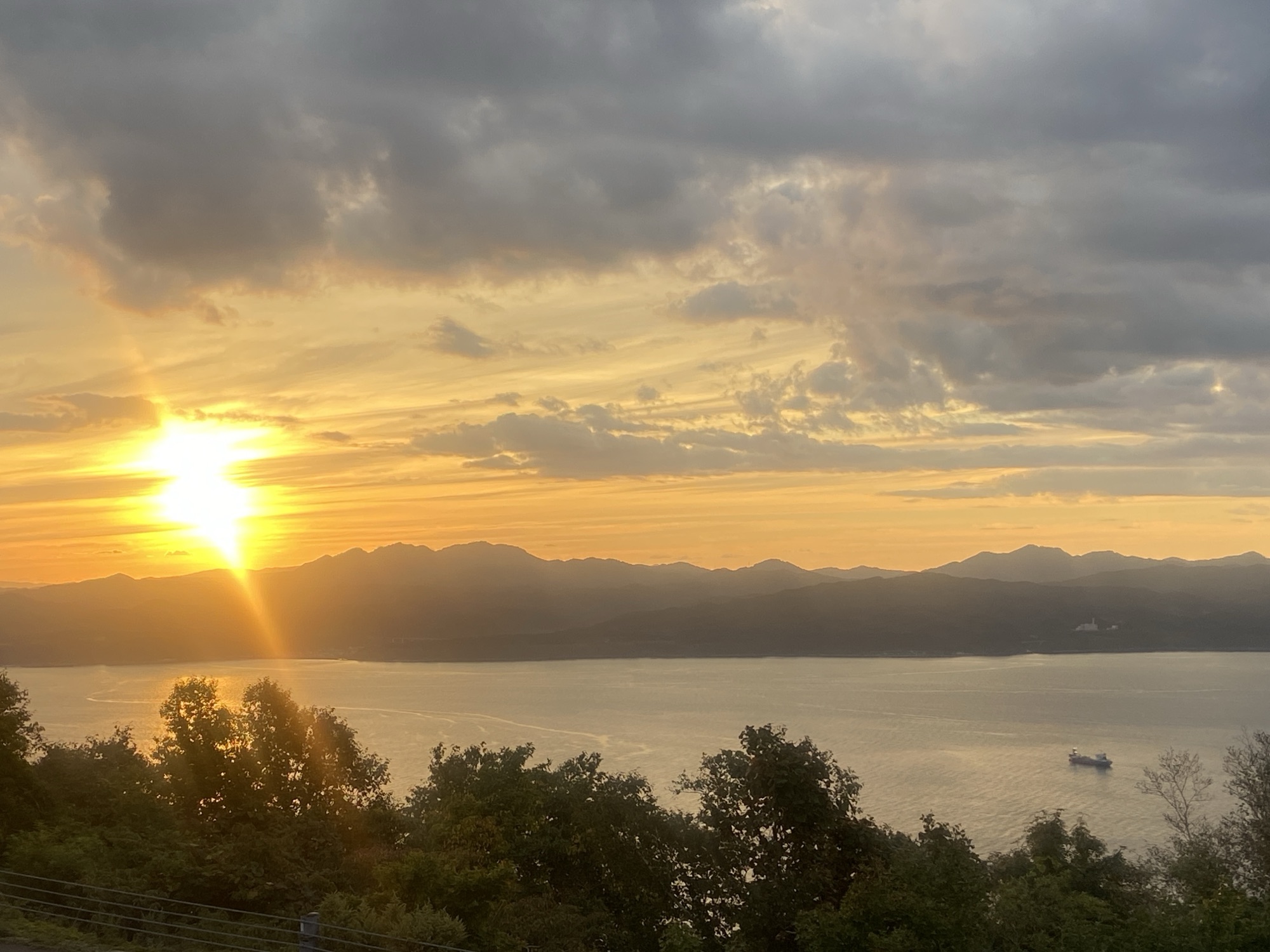
The sunset produced a beautiful yellow gradient across the cloudy sky, and the changing light over Hakodate was far more interesting to me than simply arriving at night and immediately looking for the famous illuminated cityscape.
The viewing platform, however, was extremely crowded.
Trying to get that perfect postcard-style night photograph would have meant squeezing into the crowd and waiting for the right position. But then again, Hakodate’s night view is so iconic that almost any image search will produce the same signature photograph.
If I really wanted that exact picture, I could simply buy a postcard.
So why bother?
Instead, we rode the ropeway back down and walked towards the hotel.
It was only a little after six, which gave us plenty of time before dinner.
Uni for dinner at Uni Murakami
I had booked an 8pm dinner at Uni Murakami Hakodate.
Getting to our seats was surprisingly smooth, and we ordered the course menu so that we could try uni prepared in several different ways.


The different preparations were certainly interesting, and everything was good.
But, for us, the simple raw uni sashimi was still the favourite.
There is something slightly amusing about ordering a course designed to demonstrate all the different culinary possibilities of uni and then discovering that we liked it most when it was barely changed at all.
At least we had tried one of Hakodate’s signature foods properly.
Sea urchin is particularly associated with Hokkaido, where cold, nutrient-rich waters support the local fisheries. Hakodate’s position at the southern entrance to Hokkaido and its long-established fishing economy have made seafood central to the city’s food identity, from morning-market kaisendon to squid and uni.
After dinner, we went back to the hotel and finally called it a day.
It had been a surprisingly full day — seafood markets, old trading warehouses, historic slopes, churches and temples, an abandoned house that made me curious, coffee and cake, pizza, a sunset from Mount Hakodate and, finally, uni.
Not a bad day in Hakodate.
Transport & Practical Tips
Hakodate Morning Market
The market is close to Hakodate Station, so it is easy to combine with the waterfront and red-brick warehouse area. Going early is useful if you want breakfast or seafood, but arriving too early means some shops may not yet be open.
Motomachi & the historic slopes
The churches, temples and historic streets are best explored on foot. The area is hilly, so comfortable shoes help. Hachimanzaka is particularly well known for its straight view towards the harbour.
Hakodate tram
The tram is convenient for moving between Hakodate Station, the waterfront and the Motomachi area without needing to walk the entire distance.
Hakodate Ropeway
The ropeway is the easiest way to reach the Mount Hakodate observatory. Sunset is naturally one of the busiest periods, so expect crowds and allow extra time. Weather also matters: clouds or haze can significantly affect visibility.
Manhole cards
If you collect Japanese manhole cards, check the distribution location and opening hours before going. We were already in Hakodate partly because of this little collecting mission, and it took us to places we might otherwise have skipped.


Leave a Reply