
26 September 2026
So, we were in a bit of a pickle.
Technically, we had already done most of what we wanted to do in Obihiro, and there was no real reason for us to stay another day. But there was one thing we really wanted to experience: Banei Horse Racing, which takes place on weekends. Since today happened to be race day, we decided that rather than leave Obihiro early for Lake Akan, we would linger a little longer and make the most of the day.
Our first stop was Aeon Obihiro, partly because we still had a small unfinished mission from our time travelling around Hokkaido: finding a particular pen.
After visiting several stationery shops in Hokkaido without success, we finally found it here. It was such a small thing, but after looking for it for several days, finding the pen felt like a proper little victory. Mission accomplished.
A change of plan, and a very cute dessert stop
Originally, we were planning to try another French restaurant in Obihiro because we had such a good experience with French food the previous day. We had found one with very good reviews and thought it would make a nice lunch.
Unfortunately, when we walked in, the owner told us that the restaurant was fully booked and operating by reservation only that day.
So that plan disappeared almost immediately.
Instead, we changed direction and went to SWEETS FACTORY Tokachi Toteppo Factory, where we decided that dessert was probably an acceptable replacement for our carefully planned French lunch. The café is particularly associated with Tokachi’s dairy and confectionery culture, and even its name has a connection to the area’s railway history: “Toteppo” was the nickname for the former Tokachi Railway.


The place was very cute, with parfaits that looked almost too pretty to eat. The taste was good too, but what really caught our attention was the large glass window looking out towards the garden.
And then we spotted a squirrel.
It was running around the greenery outside, completely unconcerned about the people sitting inside watching it. We ended up watching the squirrel for a while, which was probably not part of our original Obihiro sightseeing plan, but was definitely one of the nicer little surprises of the day.
Finally, it was time for Banei Horse Racing
After our dessert stop, we finally moved ourselves towards the Obihiro Racecourse, home of Banei Horse Racing.
Banei is quite different from the kind of horse racing most people imagine when they hear the words “horse race”. Instead of lightweight racehorses carrying jockeys around a flat track, Banei horses pull heavy sleds behind them. The course includes slopes, so the horses have to use considerable strength to pull the sleds over the obstacles.
That difference is what makes Banei so fascinating.
These are enormous draft horses, and when we went to see them in the stables, my first reaction was basically: oh my god, they are huge.


Literally the largest horses I think I have ever seen.
Before the race, we also explored the free horse museum, which helped put what we were seeing into context. Banei is closely tied to the history of Tokachi, where horses were historically important for agricultural work and transporting heavy loads across the farming region. What developed into modern Banei racing came from those working-horse traditions rather than from the more familiar thoroughbred racing culture.
And once we got close enough to the horses, it was difficult not to interact with them.
We bought some carrots and started feeding them.
This was actually one of the most entertaining parts of the afternoon because you could really see the differences in their personalities. Some horses wandered around their spaces looking for anyone holding carrots. One particularly feisty one kept kicking at the stable door as if demanding that we hurry up with the food.
Then there was the enormous black horse.
Compared with the more impatient ones, it seemed surprisingly gentle and simply waited patiently for people to come over and feed it.
It was fun to watch them up close because suddenly these weren’t just “racehorses” on a track. They were huge working animals with very different temperaments.
Watching the race without betting
We eventually found a place to sit and waited until around 2:40pm, when the race began.
We didn’t place any bets.
There were detailed instructions explaining how the betting worked, but honestly, the mechanism looked complicated enough, and most of the information was in Japanese, which made it feel even more intimidating. Since we weren’t there specifically to gamble, we decided that simply watching the race would be enough.
My companion and I still couldn’t resist having our own tiny unofficial competition, though.
I chose horse number 8, while my companion chose 9.


Sadly, neither of us won our imaginary bet.
Watching the race itself was much more interesting than I expected. The horses pull the heavy sleds while moving up the course, and the slopes make it obvious how much physical effort is involved. You can see the horses slow down and gather their strength before tackling the more difficult sections.
I did wince a little at the moments when the riders appeared to be whipping the horses. We were some distance away, so I couldn’t tell exactly what was happening or whether what I saw was actually a whip being used, but it was uncomfortable to watch from where we were sitting.
Still, seeing Banei in person was very different from simply reading about it. The sheer size and strength of the horses are something that photographs don’t really convey.
Banei tip
If you want to see Banei Horse Racing, check the race calendar before planning your route, because the races are not held every day. Weekends are particularly important for visitors planning around the racing schedule. It is also worth allowing extra time before the race to explore the racecourse, museum and horse areas rather than arriving just before the first race.
From Tokachi’s plains to Lake Akan
Once the race was over, it was finally time for us to leave Obihiro.
We had a drive ahead of us to Lake Akan, and after spending the day around Obihiro, it was nice to watch the scenery gradually change as we moved away from the open Tokachi landscape.
When we arrived at Lake Akan, we were greeted by the friendly hotel staff. The first thing we noticed was the temperature.

It was noticeably colder than Obihiro.
After checking in, we had a hot bath, then took a short walk towards the edge of Lake Akan before having dinner. By this point, it felt very different from the relatively open and urban atmosphere of Obihiro. Lake Akan sits within the forests and mountains of eastern Hokkaido, and the area has a strong connection with Ainu culture.
The nearby Akanko Ainu Kotan is one of Hokkaido’s major Ainu settlements, with around 120 people living there today. It is not simply a tourist attraction: it is also a living community where Ainu crafts, food, performing arts and cultural traditions continue to be practised.
That cultural background became particularly relevant to what we were doing that evening.
Kamuy Lumina after dark
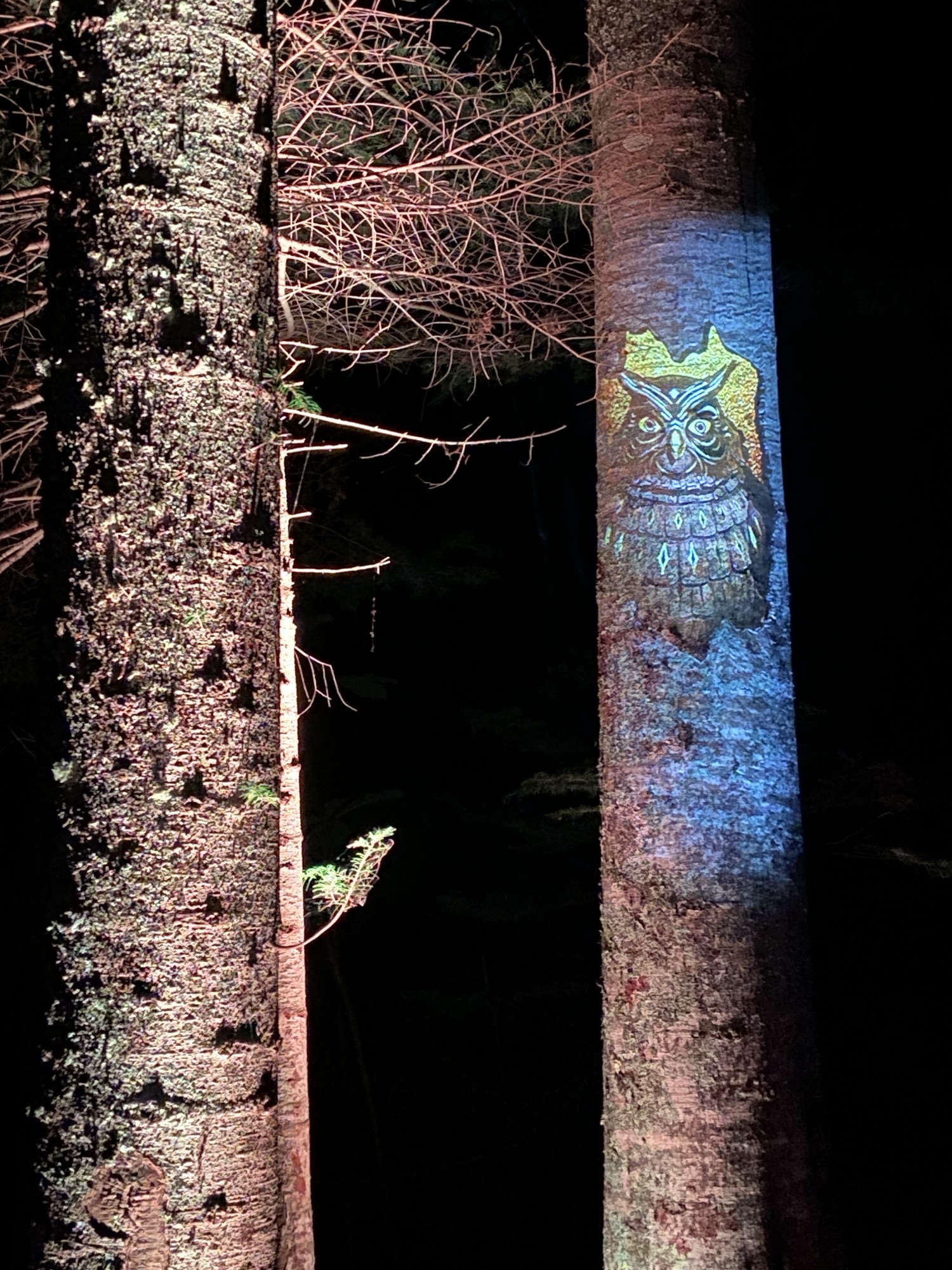
After dinner, we joined Kamuy Lumina, an interactive night walk through the forest beside Lake Akan.
By then it was properly dark.
The forest was almost completely black, although because it was around the full moon, there was still a little natural light filtering through the trees. That made the experience feel different from simply walking through a completely dark forest.
Kamuy Lumina is a roughly 1.2-kilometre night walk combining lights, sound, projections and interactive elements. It was created by Montreal-based digital art company Moment Factory in collaboration with the Lake Akan Ainu community and others involved in protecting the natural environment. The story draws inspiration from Ainu Yukar oral tradition, particularly the story of the Owl and Jaybird.
We were given staffs to use during the experience, and at various points we interacted with the lights and the forest around us.
There was something quite fun about walking through the dark with a glowing staff in our hands, following the lights and sounds through the trees.

At one point, though, I did wonder whether hitting the staff on the ground as part of the light show might also have the accidental benefit of telling any animals hiding nearby that a large group of humans was coming through.
Probably not.
But it crossed my mind.
The combination of the darkness, the forest, the lights and the full moon made the whole thing feel slightly surreal. It was cold, but that actually suited the experience.
After roughly an hour, we finished the walk and headed back to the hotel.
It had been a surprisingly full day: a stationery mission at Aeon, an unexpected dessert stop, a squirrel, some very large horses, our first Banei race, a drive into the colder landscape around Lake Akan, and finally a night walk through an illuminated forest.
Not exactly the straightforward Obihiro-to-Lake-Akan travel day we might have planned on paper, but perhaps that was the fun of it.
Kamuy Lumina tip
For late September, the official Lake Akan Ainu Kotan information lists Kamuy Lumina sessions from 6:00pm onwards, with departures every 15 minutes and a walk lasting around 50–60 minutes. The exact operating dates and ticket information should be checked for the year of travel before going.
The walk is outdoors, so warm clothing and comfortable shoes are worth having even if the daytime weather in Obihiro feels mild. The temperature around Lake Akan can feel considerably colder after sunset.





Leave a Reply