
8 October
Turpan woke us with its usual extremes: a cold, almost desert-winter breeze in the morning, and by noon, it was the familiar dry, oven-like heat again. It suddenly hit me that after almost three weeks of traveling across Xinjiang, we had not seen a single drop of rain—not even a passing drizzle. Just endlessly blue skies, dust scented with sunlight, and a climate that seems to stretch time itself.

Because Turpan’s sights are scattered far apart, we booked a car for the day. At first, I checked Ctrip—the prices were reasonable—but my indecisiveness won again, and I never confirmed the booking. In the end, we used the same method as in Kashgar: ask yesterday’s taxi driver. She quoted a fair price, we exchanged WeChat contacts, and arranged to meet in the morning. It felt casual, almost old-fashioned—like how travel used to be before apps took over everything.
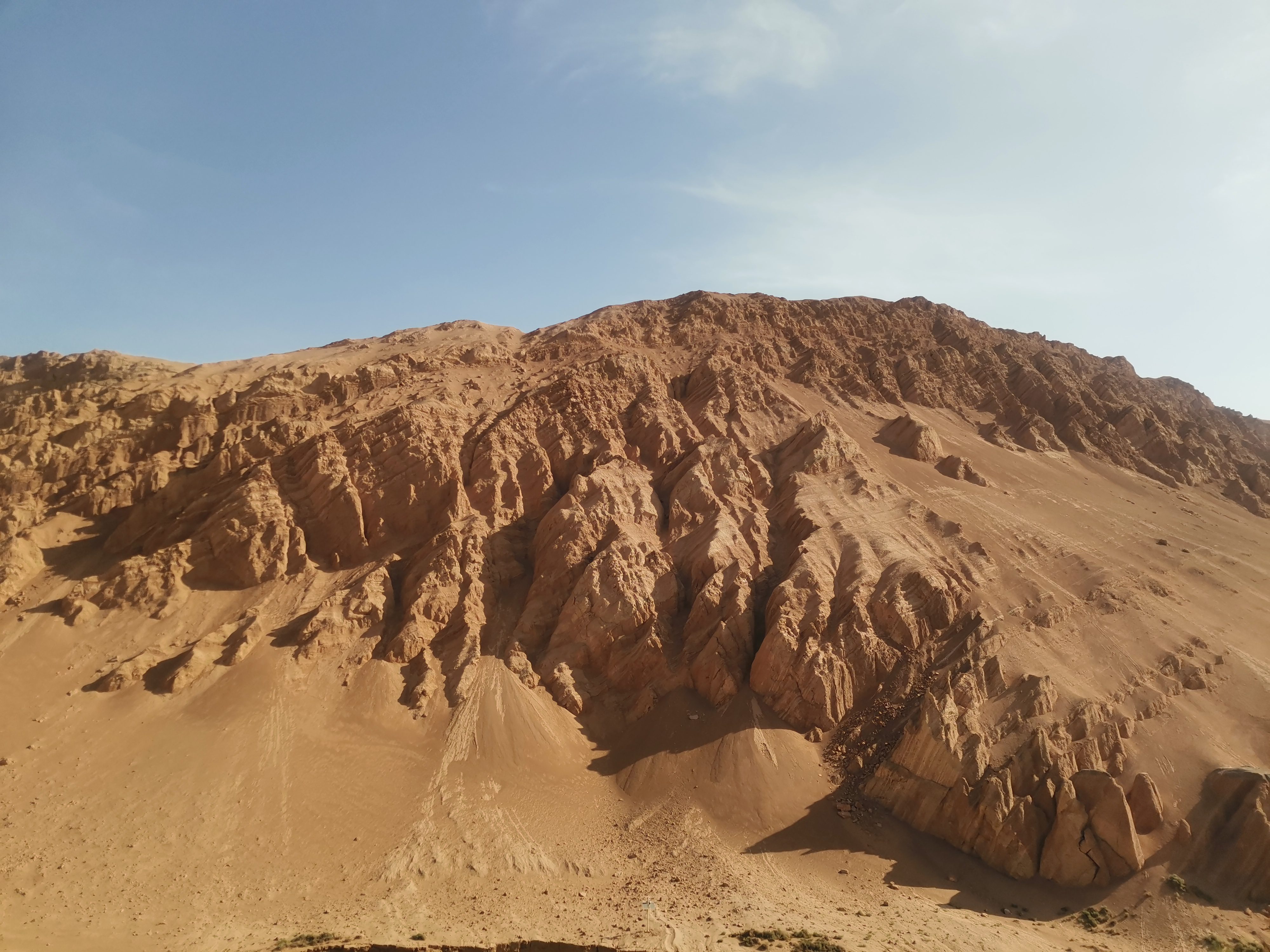
Flaming Mountain 火焰山 — More Than Just a Journey to the West Icon
Our day began with the legendary Flaming Mountain. Most people know it from Journey to the West as the fiery obstacle that Sun Wukong had to overcome, but the real mountains are breathtaking in an entirely different way.
Historical + Geological Background
Flaming Mountain sits along the northern rim of the Turpan Depression, one of the hottest places in China. The reason the mountains appear “on fire” has nothing to do with flames—they are formed from red sandstone layers rich in iron, weathered over millions of years. When sunlight hits the ridges, the iron oxidizes and glows, giving the effect of burning waves running along the slopes. Tectonic movement also pushed the sandstone upward, creating long, parallel ridges that look almost unreal.

Online reviews said you don’t need to buy the official ticket to see the mountain, and some even claimed the views from outside are better. So, we stopped at the entrance, took photos with the giant thermometer (one of many installed around Turpan), though a couple of them looked suspiciously broken or stuck at one temperature.
Still, the landscape is striking—harsh, red, carved by wind, and strangely silent. It feels like standing in the middle of geological time.
Palace of Ten Thousand Buddhas (Wanfo Palace)万佛宫 — Between History and Theme Park
Our next stop was Wanfo Palace 万佛宫. Historically, this area once had Buddhist temples with numerous cave statues and murals. Today, however, it has taken a much more entertainment-driven direction. Everywhere you turn, there are Journey to the West statues, mythical figures, bright colors, and playful decorations.


For me, it felt slightly inauthentic, almost like a fantasy park built on top of something once sacred. But I can easily imagine children loving it—Monkey King, Pigsy, and various demons coming alive in statue form, turning legend into something tangible.
Bezeklik Thousand Buddha Caves 柏孜克里克千佛洞 — Echoes of a Silk Road Civilization
Then came the real highlight of Turpan’s Buddhist heritage:
Bezeklik Thousand Buddha Caves.

These caves lie deep in the cliffs along the Mutou Valley. From the 5th to the 14th century, this region was a thriving Buddhist center. Monks, merchants, and travelers from across Asia passed through Turpan, leaving behind a blend of artistic influences—Han Chinese, Uighur, Persian, Sogdian—all visible in the murals.
A painful but important part of history
In the early 1900s, several European and Japanese explorers removed large portions of the murals.
What I appreciated is that the site honestly states the names of the explorers and which museums the murals were taken to. Standing in front of the faded walls, reading those descriptions, imagining the original colors—it feels both fascinating and heartbreaking. Some caves are almost empty except for faint outlines.
Yet the site still holds a quiet dignity. Even in fragments, the art feels alive.
Tuyugou Canyon 吐峪沟大峡谷 & Mazha Village 麻扎村 — A Living Timeline
This was, without question, our favorite part of the day.
After entering, you take a shuttle deeper into the canyon—some people walk, but honestly, the canyon heat can be merciless. Moss-colored cliffs and wind-carved ravines soon gave way to a village that seemed frozen in time.


Historical & Cultural Background
- Tuyugou Canyon is often called China’s first historical canyon, with layers of geological and cultural history overlapping.
- Mazha Village has existed for more than 2,000 years, one of the most intact Uighur adobe settlements.
- “麻扎” means “shrine” or “holy tomb,” and legend says village families are descendants of shrine guardians who protected ancient graves.
The village feels like a maze of narrow lanes, wooden doors, mud-brick homes, and clusters of grapes drying in courtyards. Local families sell freshly dried prunes—surprisingly affordable and delicious.
Walking inside felt surreal. You start imagining how villagers recognized one another in these twisting alleys, how children ran through them, how life flowed slowly but steadily through generations. It made me think of how everyone alive today is also part of living history, carrying fragments of past generations inside us.
Gaochang Ancient City 高昌故城 — Ruins of a Forgotten Capital
Our last major stop was Gaochang Ancient City, once the capital of the Gaochang Kingdom and an essential oasis station along the Silk Road. It flourished between the 6th and 13th centuries and was known for its Buddhist community—Monk Xuanzang (玄奘) stopped here to preach and study before traveling further west.


Today, Gaochang is a vast archaeological site surrounded by silence. The main city walls, temples, and palace ruins are still visible, though worn down to sand-colored outlines. Most visitors take the internal shuttle because the distances are surprisingly large. Even with the shuttle, walking under the exposed desert sun was intense—dry heat that seems to absorb sound.
We wandered through the ruins, thinking about what life here must have looked like: traders, monks, kings, farmers, guards. Eventually, the heat convinced us to cut the visit slightly short.
Dinner — 大盘鸡面 and the Reality of Xinjiang Portions
Back in the city, we decided to try 大盘鸡面.
The noodles were great, the potatoes unfortunately not fully cooked, and the portion size—as always in Xinjiang—was huge. I’m convinced that Xinjiang is best for groups of three or four. You can share taxis, share food, try more dishes, and split costs. Still, even as two people, we enjoyed every meal and every little adventure.

That dinner marked the end of our Turpan chapter, and with it, the conclusion of our Xinjiang journey.
Next, we head to Lanzhou for a transit, then finally Beijing



Leave a Reply