
31 December 2025

After our visit to Setenil de las Bodegas, we continued deeper into the Andalusian countryside toward Ronda. The drive itself felt like a quiet transition between worlds. Rolling hills stretched endlessly, dotted with modern wind turbines slowly turning in the winter breeze. It was a striking contrast: contemporary Spain harvesting clean energy, set against a landscape that has barely changed since Roman and Moorish times.
First Impressions: A City on the Edge
Once we arrived, Ronda immediately felt different from anywhere else we had been. This is not a city you simply walk into—it reveals itself gradually. Our guide first led us to a park overlooking the El Tajo Gorge, where statues and memorials pay tribute to legendary bullfighters associated with Ronda.
What intrigued me was the contradiction. Bullfighting is now heavily restricted or discouraged in Andalusia for humanitarian reasons, and yet the toreros are immortalised in bronze and stone. I don’t have strong feelings against it—what they do is undeniably dangerous and physically demanding—but the dual attitude toward bullfighting here says a lot about Spain’s ongoing negotiation between tradition and modern values.
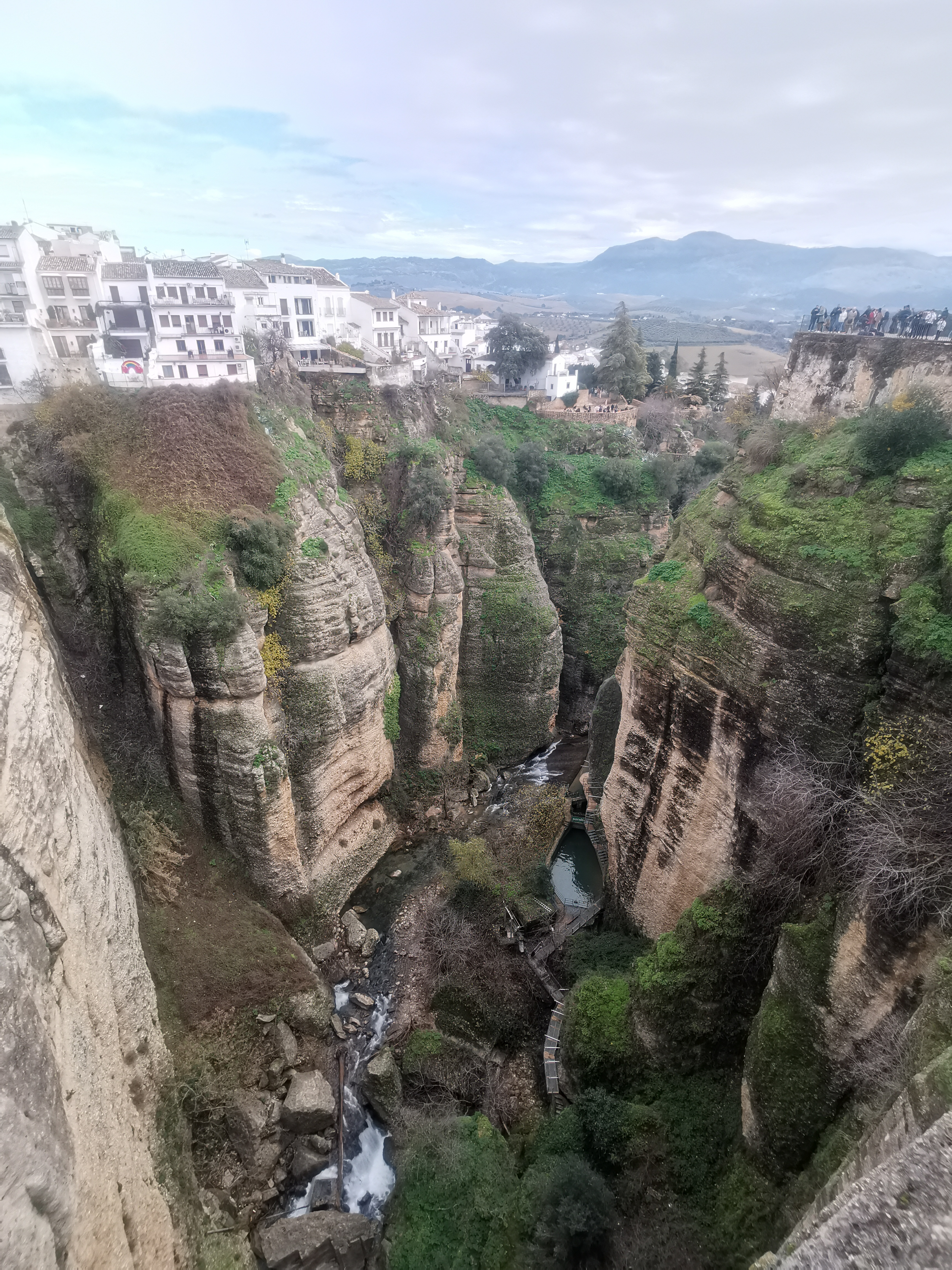
From the garden’s balcony, the view was breathtaking. Ronda doesn’t just sit on a cliff—it commands it. The city feels as though it was carefully balanced on the edge of the world, suspended between sky and stone.


Statues, Identity, and Andalusian Memory
Among the monuments was a statue of Blas Infante, often referred to as the Father of Andalusia (not Catalonia, as he is sometimes mistakenly called). Infante’s life also ended tragically: in 1936, at the outbreak of the Spanish Civil War, he was arrested by Francoist forces and executed without trial. His death transformed him from a political thinker into a lasting symbol of Andalusian identity and resistance. Infante was a key figure in shaping modern Andalusian identity in the early 20th century, advocating for regional autonomy, cultural pride, and social reform. His statues can indeed be found in many Andalusian cities, serving as reminders of a shared regional consciousness that goes beyond provincial borders.
Seeing his statue here felt fitting. Ronda, with its layered history of Iberians, Romans, Moors, and Christians, is almost a physical summary of Andalusia itself.
Ronda and Cuenca: Sister Cities on the Edge
Ronda is often compared to Cuenca, its sister city, because both are dramatically perched above deep river gorges. Like Cuenca’s famous Casas Colgadas, Ronda’s cliffside houses and viewpoints emphasise how geography shaped daily life, defence strategies, and even psychology. These were cities built to be protected by nature itself.


The Soul of Ronda: Geography and the Puente Nuevo
Ronda’s defining feature is its geography. The El Tajo Gorge, carved by the Guadalevín River, splits the city in two. Spanning this chasm is the iconic Puente Nuevo (New Bridge)—though “new” is a relative term here.
The first bridge built on this site collapsed just six years after its completion in 1735, tragically killing dozens of people. Learning from that disaster, the current Puente Nuevo was constructed using stone taken directly from the gorge itself. Work began in 1759 and took an astonishing 42 years to complete, finally opening in 1793.
Architecturally, the bridge is more than a crossing—it is a vertical structure with chambers inside, once used as a prison and later during the Spanish Civil War. The chief architect behind this ambitious project was José Martín de Aldehuela, a master builder of the late 18th century who also designed Málaga’s aqueducts and other major Andalusian works. Tragically, despite completing one of Spain’s most extraordinary engineering feats, Aldehuela is believed to have died in poverty, a sobering reminder of how little security even great architects enjoyed at the time. Walking across it today, you feel the weight of time beneath your feet. From different angles, the bridge transforms: sometimes monumental and imposing, sometimes almost delicate against the vastness of the canyon.
Standing on the bridge, surrounded by cliffs, old houses clinging to rock faces, and birds circling far below, it’s easy to understand why Ronda has inspired writers, painters, and travelers for centuries.

Plaza de Toros and the Origins of Bullfighting
Ronda is also inseparable from the history of bullfighting. The Plaza de Toros de Ronda, built in 1785, is one of the oldest and most significant bullrings in Spain. Ronda is considered the birthplace of modern bullfighting, particularly through the Romero family, who introduced the use of the red cape and formalised many of the rules still followed today.
Before bullrings existed, bullfights were held in public squares. In Ronda, this history is closely tied to the Iglesia del Espíritu Santo, one of the city’s oldest churches. The church features a rare external balcony, believed to have allowed clergy to observe bullfights held in the square below without joining the crowds. This explains a curious architectural detail nearby: a historic church with a unique balcony, said to be the only one of its kind, allowing clergy to observe bullfights without mixing with the crowd. It’s a small detail, but one that perfectly illustrates how deeply bullfighting was woven into everyday life. Even today, if you look closely at the stonework near the church entrance, you can see dark black soot stains. These marks are widely believed to be remnants from burnings and violence during the Spanish Civil War, when churches and religious buildings were targeted, leaving physical scars that still quietly testify to that turbulent period.
Today, bullfights in Ronda are infrequent, mostly limited to special events such as the annual Corrida Goyesca. Unfortunately for us, the bullring was closed for a half-day on 31 December, so we couldn’t go inside—one of those small travel regrets you accept along the way.

Food, Fatigue, and Farewell
We ended the visit with a meal at a busy local restaurant. Despite the crowds, the food was exquisitely prepared—delicate, thoughtful, and surprisingly refined. It was one of the first meals on this trip that truly felt carefully composed, not just hearty or rustic.


As evening fell, we followed the group back toward Málaga. Passing through the city centre, we finally experienced Ronda’s Christmas lights, even catching the moment when they were officially lit. Against the historic streets and stone buildings, the festive glow felt quietly magical.
It was a beautiful ending to the day—though exhaustion caught up with us quickly. We returned to rest, carrying with us the image of a city forever balanced between past and present.

Quick Facts: Puente Nuevo
- Architect: José Martín de Aldehuela
- Construction Period: 1759–1793 (42 years)
- Height: Approx. 98 metres above the Guadalevín River
- Why It Matters: Built after an earlier bridge collapsed just six years after completion, Puente Nuevo symbolises Ronda’s resilience and is one of Spain’s greatest 18th‑century engineering achievements.
- Hidden History: Interior chambers were later used as a prison, including during the Spanish Civil War.
Traces of the Spanish Civil War You Can Still See in Ronda
Ronda’s beauty often distracts from the darker layers of its past, but the Spanish Civil War (1936–1939) left visible scars across the city.

- Puente Nuevo: The bridge’s interior rooms were reportedly used to detain prisoners, and local memory links the gorge below with wartime executions.
- Iglesia del Espíritu Santo: Look closely at the black soot staining the stonework near the church doors—widely believed to be evidence of fires during anti‑clerical violence in the Civil War.
- Blas Infante Memorials: Statues and plaques across Andalusia, including Ronda, quietly commemorate Infante’s execution, turning public space into places of remembrance.
These details are easy to miss, but once seen, they permanently change how you experience the city.
Ronda as Part of an Andalusian Journey
Ronda fits naturally into a wider Andalusian road trip, where geography, white villages, and layered history connect seamlessly:
- Setenil de las Bodegas: Cave houses carved directly into rock, offering a perfect contrast to Ronda’s vertical drama.
- Málaga: A coastal gateway blending Roman ruins, Moorish fortresses, and contemporary Andalusian life—especially atmospheric during the Christmas season.
- White Villages Route (Pueblos Blancos): Zahara de la Sierra, Grazalema, and Arcos de la Frontera add rural depth to the journey.

Seen together, these destinations reveal Andalusia not as isolated highlights, but as a continuous cultural landscape shaped by stone, survival, and adaptation.
Practical Tips for Visiting Ronda
- Getting There: Ronda is about 1.5–2 hours from Málaga by car. Trains are available but limited; driving offers flexibility, especially when combining with Setenil de las Bodegas.
- Bridge Viewpoints: For the best photos of Puente Nuevo, walk down to Mirador de Aldehuela or the lower paths into the gorge.
- Bullring Tickets: Check opening hours carefully, especially on public holidays like 31 December, as closures or half-days are common.
- Timing: Winter offers fewer crowds and dramatic light, but daylight hours are shorter—plan viewpoints earlier in the day.
- Footwear: The historic centre involves uneven stone paths and inclines; comfortable shoe



Leave a Reply