
Seville to Granada | 28 Dec 2025
Our departure from Seville’s Plaza de Armas was a masterclass in the quiet chaos of Spanish transit. We stood at our assigned platform, eyes glued to the monitor, only to watch a driver from a completely different bus company pull into an adjacent bay and begin a spirited announcement in Spanish.
As a traveler, there is a specific kind of tension that arises when you realize the crowd is shifting and you don’t know why. We showed our ALSA tickets to the driver—who spoke no English—and with a simple nod, we were ushered onto a bus that didn’t match our paperwork.
While we were comfortably seated, I saw a few Asian girls who had been waiting beside us on the platform. They were still there, looking at their phones, presumably waiting for the same ALSA bus we had been expecting—a bus that was nowhere to be seen.
I debated with myself: Should I leave the bus and ask them if they were also going to Granada? They could have been waiting for another ride entirely, as there were still many people on the platform. But while I was discussing it with my travel partner, the bus started to drive. It was too late. We weren’t sure if the bus driver would even understand us if we tried to stop him, and frankly, we weren’t even 100 percent sure we were on the right bus ourselves.
We eventually did a bit of research and realized that this was a regional bus company. They serve local routes and often exist in a state of both competition and cooperation with ALSA. We figured that perhaps, because it was the Christmas season, they were working together to share the passenger load.
Still, for the first half hour, we sat with Google Maps open, tracking our route to ensure we were actually moving toward Granada and not some other city. It wasn’t until thirty minutes in that we were pretty sure we’d make it. I just hope those girls managed to get on their intended bus on time.

The Arrival: Into the Heart of the Nasrid Kingdom
We reached Granada relieved and happy. A small logistical win: our Tarjeta Multiviaje transport card from Seville worked here too. We took the local bus to Hotel Macia Plaza, located at the foot of the Albaicín.
Granada is very cold—a sharp, high-altitude chill that rolls off the snow-capped Sierra Nevada mountains. But the cold feels fitting for a city defined by its dramatic ending. For over 250 years, Granada was the capital of the Nasrid Kingdom, the last Muslim-ruled state in the Iberian Peninsula. While the rest of Spain fell to Christian forces, Granada survived as a center of art, science, and trade, protected by the mountains and the diplomatic cunning of its rulers.
Everything changed in 1492. As Christopher Columbus was seeking funding for his voyage, the Catholic Monarchs, Ferdinand and Isabella, were at the gates of Granada. When the last sultan, Boabdil, surrendered the keys to the city, it marked the end of the 800-year era of Al-Andalus. Legend says that as Boabdil rode away, he turned back to look at the city and wept. His mother’s response was harsh: “Do not weep like a woman for what you could not defend like a man.” That spot is still known today as El Suspiro del Moro (The Moor’s Last Sigh).
The Walk: Carrera del Darro & The River’s Edge
From the hotel, we walked up to the riverside along the Carrera del Darro. This street is often cited as the most beautiful in Spain, and it’s easy to see why. To your right, the Darro River rushes below stone bridges built in the 11th and 14th centuries; to your left, the heavy stone walls of Renaissance palaces hide secrets of the past.
Since it had rained slightly before, the cold was biting, turning the wet cobblestones into mirrors reflecting the dim streetlights. This path was once the main artery between the Alhambra (the fortress of the rulers) and the Albaicín (the city of the people).


Mirador de San Nicolás: The Red Fortress
We reached the Mirador de San Nicolás, the iconic viewpoint where Bill Clinton once famously claimed to have seen “the most beautiful sunset in the world.”
Standing there, we looked across the ravine at the Alhambra (from the Arabic Al-Qal’a al-Hamra, meaning “The Red Fortress”). Despite being the most-visited monument in Spain, we had the feeling we wouldn’t get to see the inside. Tickets are a logistical battlefield; we tried a week before arrival, but they were long gone. Even without entering the Nasrid Palaces, just being at the Mirador allows you to grasp the scale of this palace-fortress. It was designed not just for defense, but as a “Paradise on Earth,” filled with the sound of running water to remind the desert-born Moors of the oasis they had built in the mountains.

The Albaicín and Sacromonte: Labyrinths and Legends
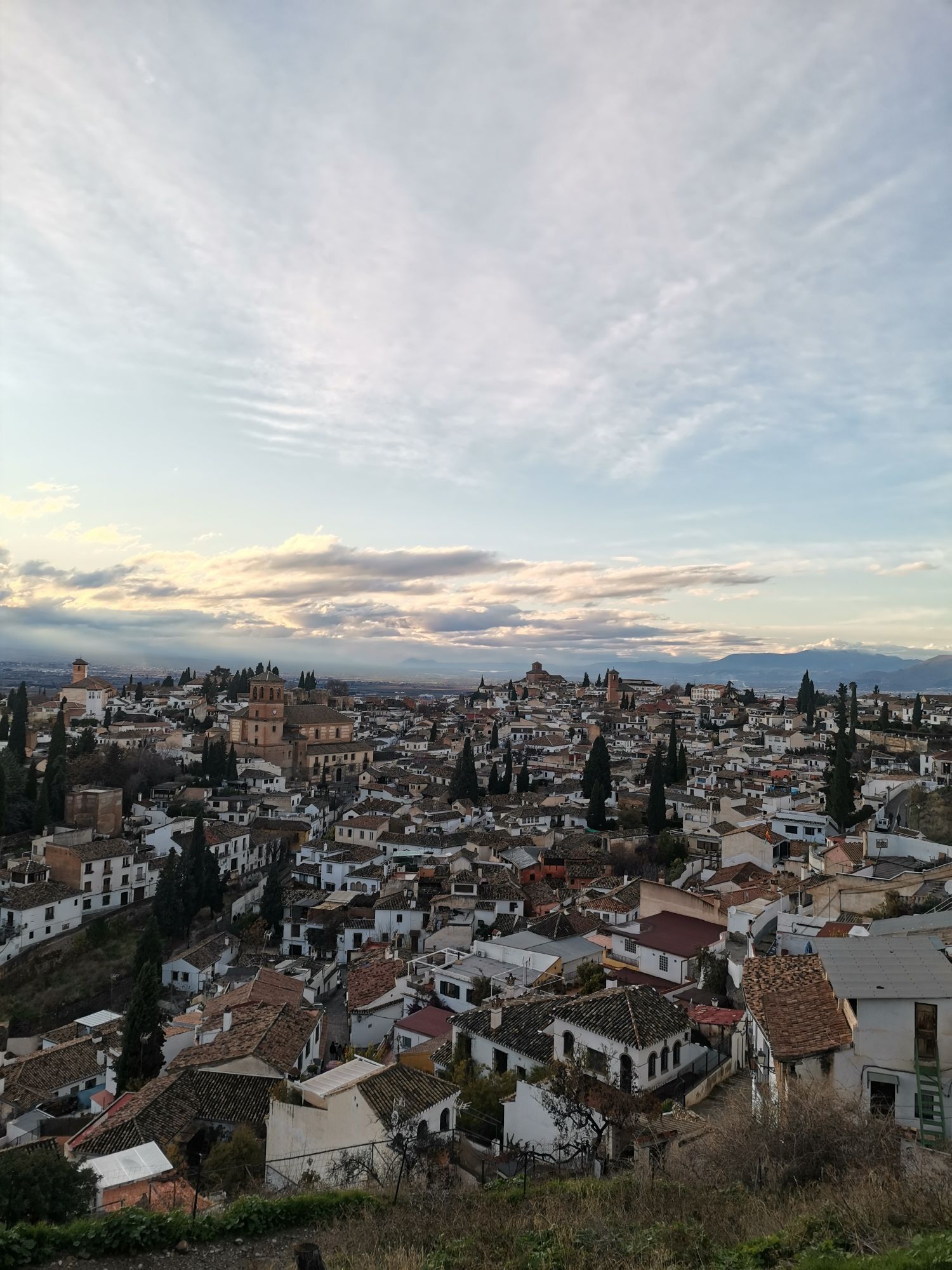
We followed the curves of the streets up into the Albaicín, a UNESCO World Heritage site that still retains its medieval Moorish layout. It is a labyrinth of white-washed walls and hidden gardens called Cármenes.
We pushed further into the Sacromonte area, famous for its cuevas (caves). After the Reconquista, this area became a refuge for the marginalized—Gitanos (Roma people), Jews, and Muslims who refused to convert. They carved homes directly into the soft rock of the hillside. Today, these caves are the birthplace of Zambra, the most raw and visceral form of Flamenco. We did the climb up, our breath visible in the air, taking tons of photos of the Alhambra as it loomed over the valley, illuminated like a crown of fire against the dark mountains.


The Descent and Dinner
Afterward, we walked down through the quietest stretches of the Albaicín. Because we hadn’t researched which specific alleyways were the safest after dark, we stuck to the streets with more people. There is a beautiful, slightly eerie stillness to these white-walled alleys; you can almost hear the ghosts of the 15th century in the echo of your own footsteps.
Dinner was a slow affair at a large pub-style restaurant. With only three servers for the whole establishment, it was a lesson in patience. But after the morning’s bus stress and the freezing walk, an hour of warmth was exactly what we needed before retreating to our hotel.




Leave a Reply